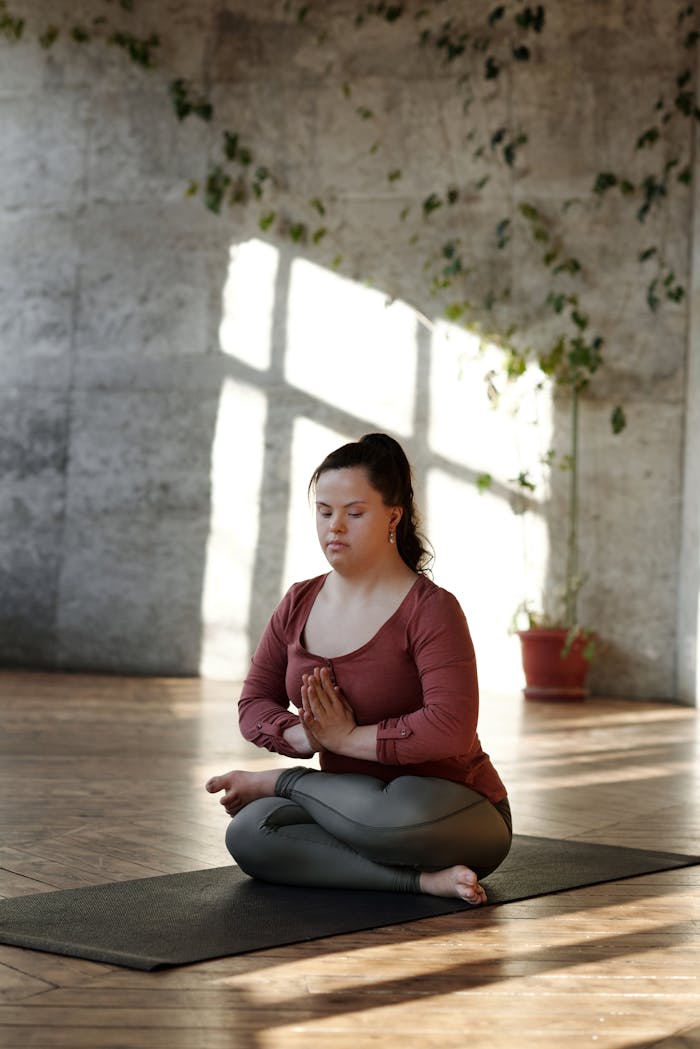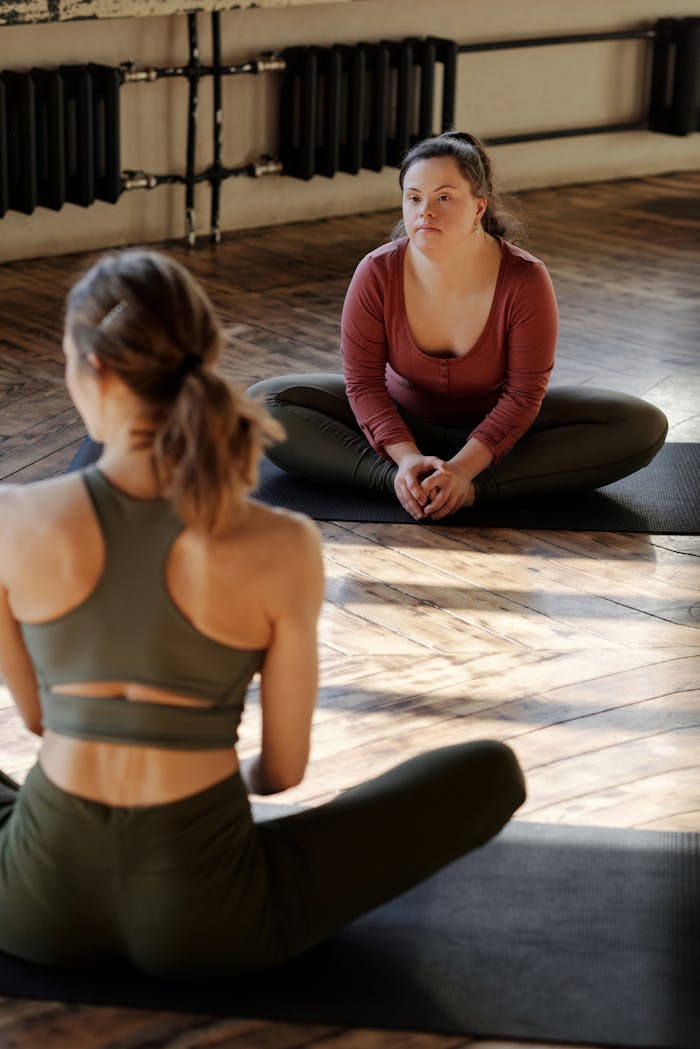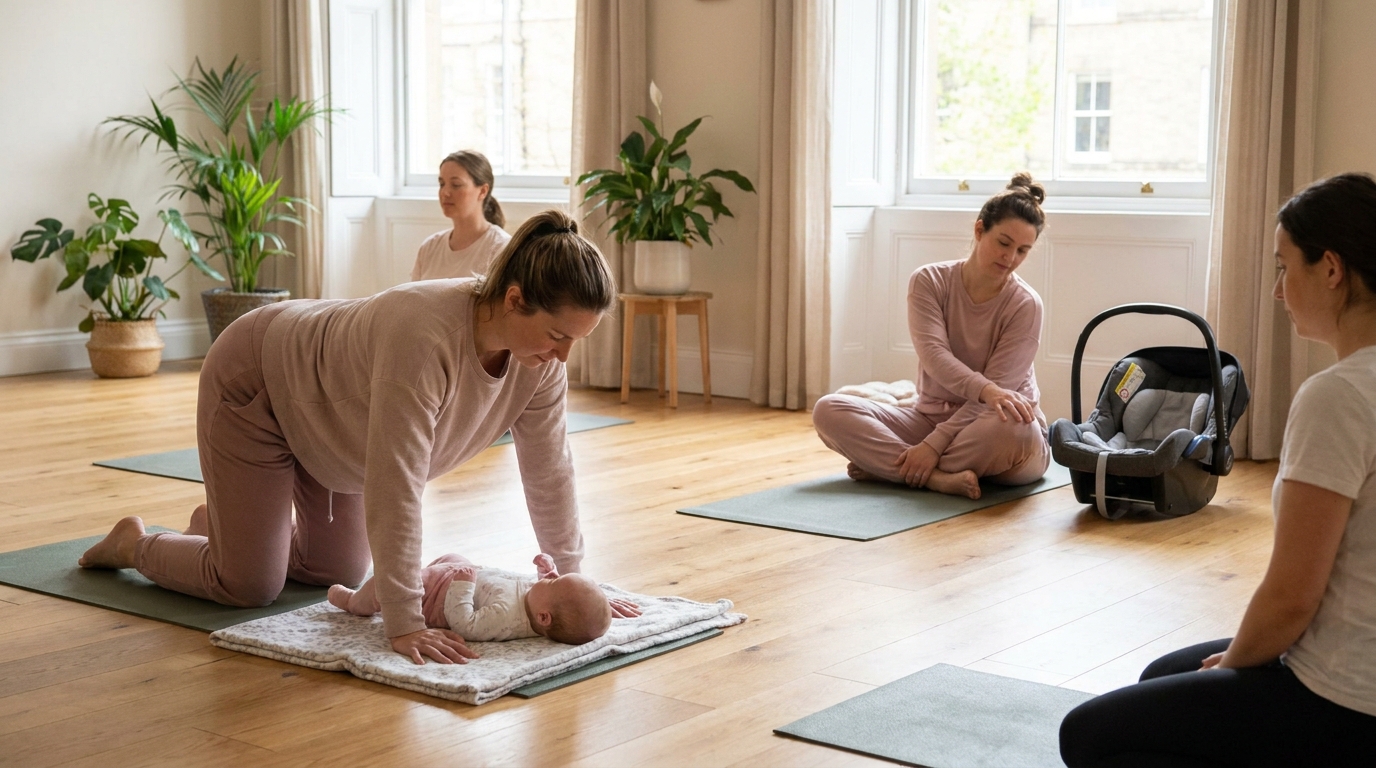
Postnatal yoga is a gentle, supportive way for a mother or birthing parent to return to the body after birth with patience, reverence, and care. It is not a race to “get your body back.” In the spirit of yoga, it is a sacred invitation to come home to yourself—breath by breath, day by day.
After birth, the body is healing on many levels. Muscles have stretched. The pelvic floor has worked deeply. The nervous system may feel tender. Sleep may be broken. Emotions may rise and fall like waves. Postnatal yoga offers simple practices to support healing, calm the mind, rebuild strength, and reconnect with the heart.
In Sanskrit, the word yoga means “union.” It points to the joining of body, breath, mind, and spirit. In the postnatal season, yoga can also become union with your baby, your new identity, and the quiet wisdom of your own inner guide.
Postnatal yoga may include:
- Gentle breathing practices
- Pelvic floor awareness
- Simple stretches for the neck, shoulders, back, and hips
- Core rehabilitation with care
- Restorative yoga poses
- Meditation and mantra
- Baby-and-me movement
- Deep relaxation
This path is practical. You do not need to be flexible. You do not need a quiet house. You do not need an hour. Even five mindful breaths can be yoga when offered with sincerity.
A Humble Beginning After Birth
The postnatal period asks us to soften our expectations. Some days, your practice may be a full gentle yoga sequence. Other days, it may be lying down with one hand on your heart and one hand on your belly.
Both are worthy.
In the Bhagavad Gita, Lord Krishna teaches the beauty of steady effort without attachment to results. This is very helpful for postnatal yoga. We practice not to become perfect, but to become present.
Your yoga mat becomes a place of kindness. Your breath becomes a prayer. Your body becomes not a project to fix, but a sacred home to care for.
When Can You Start Postnatal Yoga?
Every birth is different. Please speak with your doctor, midwife, pelvic health physiotherapist, or trusted healthcare provider before beginning postnatal yoga—especially if you had a cesarean birth, tearing, pelvic pain, heavy bleeding, prolapse symptoms, diastasis recti, high blood pressure, or any complications.
As a general guide:
- In the first days and weeks, focus on rest, breathing, and gentle awareness.
- Around 6 weeks postpartum, many people receive medical clearance for gentle exercise.
- After a cesarean birth, healing may take longer, and deep core work should be approached slowly.
- If you feel pain, pressure, heaviness, leaking, dizziness, or increased bleeding, pause and seek guidance.
Postnatal yoga should feel nourishing, not forceful.
Why Postnatal Yoga Supports Healing
The postnatal journey is not only physical. It is emotional, mental, energetic, and spiritual. Yoga respects this wholeness.
In the Yoga Sutras of Patanjali, yoga is described as the calming of the fluctuations of the mind: yogas chitta vritti nirodhah. In simple words, yoga helps quiet the restless movements of the mind. For a new parent, this can be deeply healing. When sleep is limited and responsibilities are constant, even small moments of inner stillness can feel like a blessing.
Postnatal yoga gives you tools to meet this season with steadiness and compassion.
Reconnecting With the Body
After birth, many people feel unfamiliar in their bodies. The belly may feel soft. The posture may change from feeding, carrying, and rocking the baby. The shoulders may become tight. The lower back may ache. The pelvic floor may feel weak, tense, or hard to sense.
Postnatal yoga helps rebuild body awareness gently. Instead of pushing through discomfort, you learn to listen.
This listening is part of ahimsa, a Sanskrit word meaning “non-harming.” Ahimsa is one of the foundational principles of yoga. In postnatal life, ahimsa means practicing in a way that honors healing. It means choosing patience over pressure. It means remembering that your body has done something profound.
Calming the Nervous System
The early months after birth can bring great joy, but also exhaustion and overwhelm. Your nervous system may be alert from night waking, feeding schedules, crying, and constant care.
Slow breathing, gentle movement, and supported rest activate the parasympathetic nervous system—the part of the body that helps you relax, digest, repair, and feel safe.
A simple practice like lengthening the exhale can send a message to the body: “I am safe in this moment.”
This does not make the challenges disappear, but it helps you meet them with more steadiness.
Supporting Core and Pelvic Floor Recovery
Pregnancy and birth affect the deep core system, including the diaphragm, abdominal muscles, back muscles, and pelvic floor. Postnatal yoga can help these parts work together again.
But the key is gentleness.
Many new mothers are told to “strengthen the core,” but early postpartum core recovery is not about intense abdominal exercises. It begins with breath, alignment, and awareness.
A wise postnatal yoga practice supports:
- Diaphragmatic breathing
- Pelvic floor relaxation and activation
- Gentle abdominal reconnection
- Good posture for feeding and carrying
- Safe strengthening over time
If you suspect diastasis recti, which is a separation of the abdominal muscles common after pregnancy, avoid strong crunches, planks, and deep backbends until assessed by a qualified professional.
How to Practice Postnatal Yoga Safely
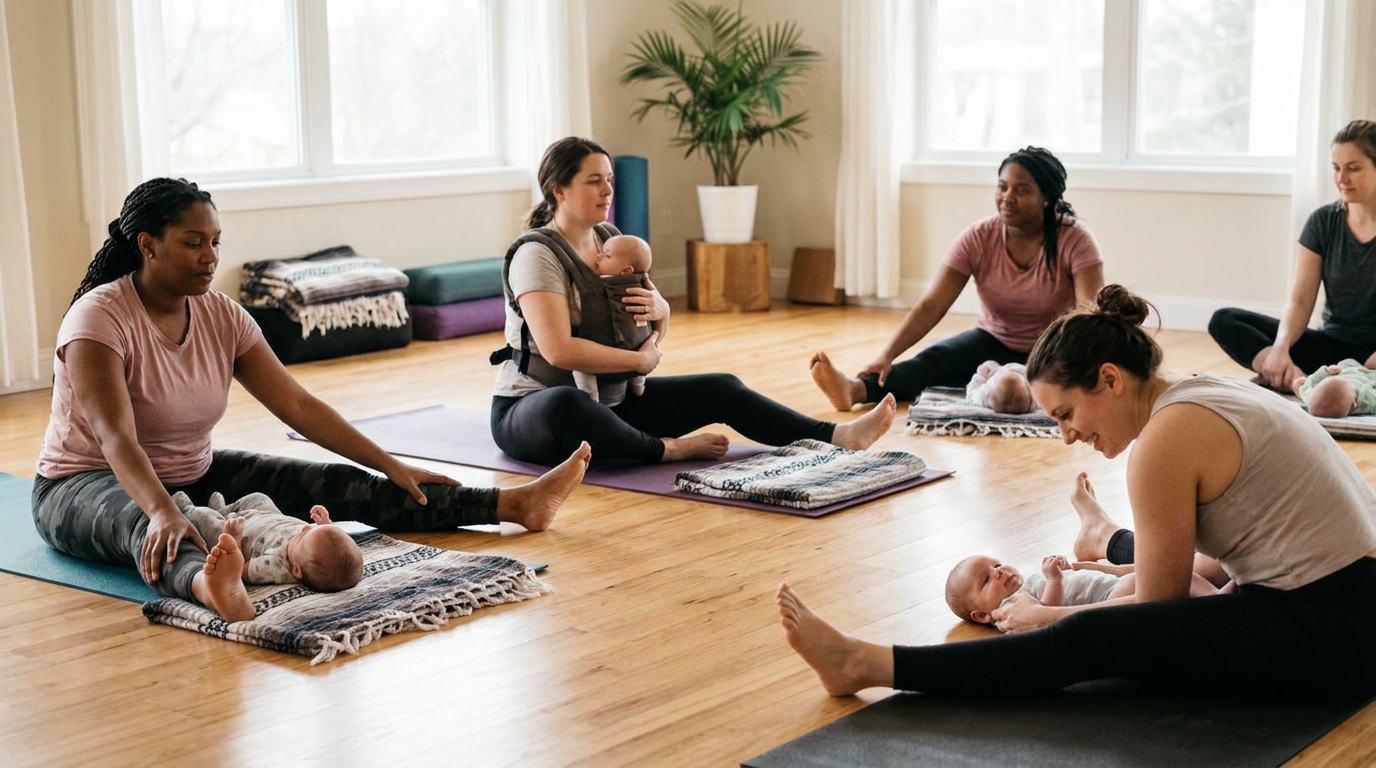
Postnatal yoga is best practiced with tenderness. The body is healing. Hormones may still be affecting joints and ligaments, especially if breastfeeding or chestfeeding. The mind may be tired. This is a time for slow, mindful progress.
Before you begin, create a simple intention. In Sanskrit, sankalpa means a heartfelt resolve or inner intention. Your sankalpa might be:
- “I will listen to my body.”
- “I honor my healing.”
- “I am enough in this moment.”
- “May this practice nourish me and my baby.”
Let your practice be an offering, not an obligation.
Safety Guidelines for Postnatal Yoga
Keep these reminders close:
- Get medical clearance before beginning movement beyond gentle breath and awareness.
- Stop if you feel pain, heaviness, pelvic pressure, leaking, dizziness, or increased bleeding.
- Avoid intense core work in the early postpartum months.
- Avoid deep twists, strong backbends, and long planks until strength and stability return.
- Move slowly when getting up and down.
- Use props such as pillows, blankets, bolsters, and blocks.
- Practice near a wall or chair if balance feels uncertain.
- Rest whenever needed.
Your body’s signals are sacred. Yoga teaches us to listen.
Breath First: The Foundation of Healing
In yoga, pranayama means breath regulation. Prana means life force or vital energy. Ayama means expansion or control. In simple terms, pranayama is the practice of guiding the breath to support body and mind.
For postnatal yoga, start with gentle breathing.
Belly and Rib Breath
Lie on your back with knees bent, or sit comfortably with support.
Place one hand on your lower ribs and one hand on your belly.
Inhale softly through the nose. Feel the ribs widen gently.
Exhale slowly. Feel the ribs soften and the belly naturally settle.
Practice for 5 to 10 breaths.
Do not force the belly outward. Do not grip the abdomen. Let the breath be easy.
This practice helps reconnect the diaphragm, pelvic floor, and deep core.
Exhale With Pelvic Floor Awareness
As you inhale, imagine the pelvic floor softening like a flower opening.
As you exhale, gently lift the pelvic floor as if picking up a tissue with the muscles at the base of the pelvis.
Keep the effort very light—about 20 to 30 percent.
Then fully release.
This is not about squeezing hard. It is about awareness, coordination, and relaxation. Many postpartum bodies need both strengthening and softening.
Gentle Movements for Early Postnatal Recovery
These movements can be helpful after medical clearance and when they feel comfortable.
Neck and Shoulder Rolls
Sit tall with support. Slowly roll the shoulders up, back, and down.
Move the head gently from side to side, as if saying “no” very softly.
Then tilt one ear toward one shoulder and breathe into the side of the neck.
This helps ease tension from feeding, holding, and carrying your baby.
Cat-Cow Pose
In Sanskrit, this movement is often called Marjaryasana-Bitilasana. Marjari means cat, and Bitila means cow.
Come to hands and knees, or place your hands on a chair or bed if the wrists are tender.
Inhale, gently lengthen the spine and open the chest.
Exhale, round the back softly and let the head relax.
Move slowly for 5 to 8 rounds.
Avoid pushing the belly downward. Keep the movement gentle and supported.
Supported Child’s Pose
Child’s Pose is called Balasana in Sanskrit. Bala means child.
Place a pillow or bolster under the chest. Kneel with knees wide, or keep them closer if that feels better.
Rest forward with support. Turn the head to one side, then the other.
Breathe into the back body.
This pose can feel emotionally tender after birth. If it does not feel good, skip it. Yoga always offers another way.
Supported Bridge Pose
Bridge Pose is called Setu Bandha Sarvangasana. Setu means bridge.
Lie on your back with knees bent and feet hip-width apart.
Inhale.
Exhale, gently press the feet down and lift the hips a small amount.
Inhale at the top.
Exhale, slowly lower.
Repeat 5 times.
For a restorative version, place a pillow or yoga block under the sacrum and rest. Avoid this if it creates pressure or discomfort.
Check out the latest yoga guides on yoga guides for helpful tips and advice.
A Simple Postnatal Yoga Sequence
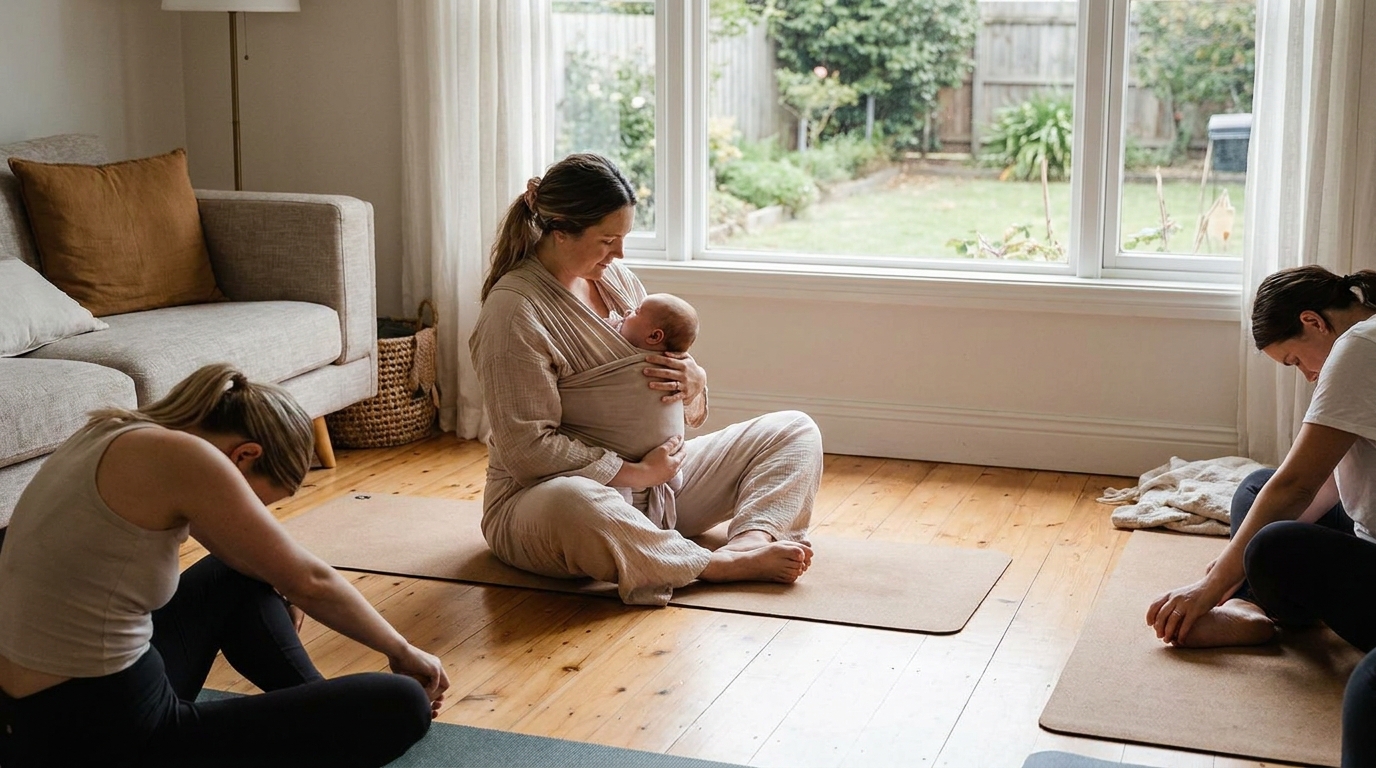
This gentle postnatal yoga sequence is designed for a calm 15 to 25-minute practice. You can do the whole sequence or choose only one part. Please adapt according to your healing, energy, and medical guidance.
Let your baby be nearby if that feels right. If your baby cries, pause. Caring for your baby is not an interruption to yoga. It is part of your yoga.
Step 1: Arrive With Devotion
Sit or lie comfortably.
Place one hand on your heart and one hand on your belly.
Close your eyes if that feels safe.
Take five slow breaths.
Silently say:
“I am here. I am healing. May I be kind to myself.”
This simple moment brings bhakti into the practice. Bhakti means devotion or loving connection with the Divine, with life, or with the sacredness of the present moment. You do not need to follow any particular religion to practice bhakti. It can be as simple as gratitude, humility, and love.
Step 2: Gentle Breath and Pelvic Floor Awareness
Practice 8 to 10 rounds of rib breathing.
On each exhale, gently engage the pelvic floor and lower belly.
On each inhale, soften and release.
Imagine the breath moving like a wave. Nothing forced. Nothing rushed.
Step 3: Seated Side Stretch
Sit on a folded blanket, chair, or cushion.
Place the right hand beside you.
Inhale, lift the left arm.
Exhale, lean gently to the right.
Breathe into the left ribs.
Return to center and switch sides.
This opens the side body, which can become tight from feeding and carrying.
Step 4: Cat-Cow Flow
Come to hands and knees or place hands on a stable surface.
Move through gentle Cat-Cow for 5 to 8 rounds.
Let the breath guide the movement.
Keep the belly softly supported.
Step 5: Low Lunge With Support
From hands and knees, step one foot forward or come into a supported kneeling lunge near a chair.
Keep the movement small.
Place hands on blocks, a chair, or your thigh.
Breathe into the front of the hip.
Hold for 3 to 5 breaths, then switch sides.
This can ease tight hip flexors, especially after long periods of sitting.
Step 6: Supported Bridge
Lie on your back with knees bent.
Practice 5 gentle bridge lifts.
Move with the breath.
If lifting feels too much, simply press the feet into the floor on the exhale and release on the inhale.
Step 7: Restorative Relaxation
Lie on your side with a pillow between your knees, or rest on your back with support under the knees.
Cover yourself with a blanket.
Relax the jaw, shoulders, belly, and pelvic floor.
Stay for 3 to 5 minutes if possible.
If the baby is with you, you may place a hand on your baby and breathe together.
This is not “doing nothing.” This is healing.
How Postnatal Yoga Helps Daily Life
The true beauty of yoga is that it travels with you. It is not limited to the mat. Postnatal yoga can support how you feed your baby, lift your baby, rest, breathe, and respond to stress.
In the Yoga Sutras, Patanjali speaks of abhyasa and vairagya. Abhyasa means steady practice. Vairagya means non-attachment. For a new parent, this teaching is precious.
You practice when you can. You release guilt when you cannot.
This is yoga in real life.
Yoga for Feeding Posture
Whether breastfeeding, chestfeeding, or bottle-feeding, posture matters.
Try this:
- Sit with your back supported.
- Bring the baby to your body rather than rounding your body toward the baby.
- Place pillows under your arms.
- Keep both feet supported.
- Relax your jaw and shoulders.
- Take slow breaths during feeding.
A simple mantra during feeding can be:
“Inhaling, I receive. Exhaling, I soften.”
Mantra means a sacred sound, word, or phrase used to focus the mind. It does not need to be complicated. A loving phrase repeated with sincerity can become a mantra.
Yoga for Carrying and Lifting Baby
Before lifting your baby, pause and exhale.
Bring the baby close to your body.
Bend your knees slightly.
Avoid twisting while lifting.
Use your breath: exhale as you lift.
This protects the back and supports the deep core.
These little moments are postnatal yoga. They are mindful movement woven into daily care.
Yoga for Emotional Balance
Postnatal emotions can be vast. Love, joy, fear, grief, irritability, tenderness, and exhaustion may all visit. Yoga does not ask you to deny any of them.
Instead, yoga offers a safe inner space to witness.
If you feel overwhelmed, try this grounding practice:
Look around the room.
Name five things you can see.
Feel your feet or body touching the ground.
Take a long exhale.
Place a hand on your heart.
Say, “This moment is hard, and I am not alone.”
If you experience ongoing sadness, anxiety, intrusive thoughts, panic, rage, or hopelessness, please reach out to a healthcare provider or mental health professional. Postpartum depression and anxiety are common and treatable. Asking for help is an act of courage and love.
How Else Can You Rejuvenate With Postnatal Yoga?
Rejuvenation is not only exercise. In yoga, true rejuvenation includes rest, nourishment, breath, community, and spiritual remembrance.
The Sanskrit word shakti means energy, power, or divine feminine creative force. After birth, your shakti has been poured into bringing life, caring for life, and adjusting to a new rhythm. Postnatal yoga helps restore this energy gently.
Practice Restorative Yoga
Restorative yoga uses props to support the body in restful poses. This is especially helpful when you are tired but wired, or when you need deep rest without falling asleep immediately.
Try these restorative postnatal yoga poses:
Supported Reclined Rest
Place pillows behind your back so your chest is slightly lifted.
Bend the knees and support them with cushions.
Rest your arms comfortably.
Breathe naturally for 5 minutes.
This can open the chest after feeding and soothe the nervous system.
Legs on a Chair
Lie on your back and place your calves on a chair or couch.
Keep the knees bent.
Rest the arms by your sides.
Stay for 3 to 8 minutes.
If lying on your back feels uncomfortable, come out and rest on your side.
Side-Lying Savasana
Savasana means “corpse pose,” a posture of deep rest and surrender.
For postpartum comfort, lie on your side with pillows under the head, between the knees, and in front of the chest.
Let the whole body be held.
This pose is simple and deeply healing.
Include Baby in Your Practice
Baby-and-me postnatal yoga can be sweet and practical. It allows you to move while bonding with your child.
You might try:
- Singing a gentle mantra while rocking
- Practicing seated breathing while baby rests in your lap
- Doing shoulder rolls while holding baby safely
- Practicing gentle bridge while baby lies nearby
- Taking mindful walks with rhythmic breathing
Let go of the idea that practice must be quiet. A baby’s sounds can become part of the practice. A pause to feed or comfort your baby can become a devotional act.
In bhakti, love itself is the path.
Use Mantra and Meditation
Meditation after birth does not need to be long. Even one minute counts.
Try this simple heart meditation:
Sit or lie down.
Place your hands on your heart.
Inhale and silently say, “I am held.”
Exhale and silently say, “I soften.”
Repeat for 10 breaths.
You may also use the mantra Om Shanti. Om is considered a sacred sound representing wholeness. Shanti means peace. Om Shanti means “peace” or “may there be peace.”
Chant softly or repeat inwardly:
Om Shanti, Shanti, Shanti.
May there be peace in the body.
May there be peace in the mind.
May there be peace in the home.
Building Strength With Patience
As the weeks and months pass, your postnatal yoga practice can gradually become stronger. But strength should arise from stability, not strain.
The Bhagavad Gita reminds us that yoga is balance. Krishna describes yoga as not too much and not too little—balanced in eating, sleeping, working, and resting. This teaching is deeply relevant postpartum.
A balanced postnatal yoga practice includes effort and ease.
In Sanskrit, sthira means steadiness and sukha means ease. The Yoga Sutras say that posture should be steady and comfortable: sthira sukham asanam. This is a beautiful guide for postpartum movement.
If a pose makes you grip, hold your breath, or feel pressure downward, it is not yet the right pose. Choose a gentler version.
Signs You Are Ready to Progress
You may be ready for more strengthening when:
- You can breathe smoothly during movement.
- You do not feel pelvic heaviness or pressure.
- You do not leak urine during or after practice.
- Your bleeding has stopped and does not return with movement.
- Your core feels responsive, not strained.
- You have medical clearance.
- You feel energized after practice, not depleted.
Progress slowly. Healing is not linear. Some days you may feel strong; other days you may need rest. Both are part of the path.
Gentle Strengthening Poses
When ready, and with guidance if needed, you may explore:
- Chair Pose at the wall
- Modified Side Plank with knees down
- Bird Dog with small movements
- Supported Warrior II
- Wall Push-Ups
- Gentle Squats with breath awareness
Always coordinate with the breath. Exhale during effort. Keep the pelvic floor responsive, not clenched.
What to Avoid in Early Postnatal Yoga
It is often wise to avoid or delay:
- Full planks
- Crunches and sit-ups
- Strong twists
- Deep backbends
- Intense vinyasa flows
- Jumping movements
- Breath retention
- Hot yoga
- Strong abdominal gripping
- Any pose causing pain, pressure, or leaking
These practices may return later, but there is no hurry. The postnatal season is worthy of respect.
Creating a Sustainable Postnatal Yoga Routine
A realistic routine is better than a perfect one. New parenthood is full of changing rhythms. Your yoga practice should support your life, not add pressure.
Think small and steady.
Five minutes daily may serve you better than one long class once a month. But if one class a month is what you can do, let that also be enough.
A 5-Minute Daily Practice
When time is short, try this:
- Three breaths with hands on heart and belly
- Five gentle shoulder rolls
- Five seated side stretches
- Five rounds of pelvic floor breath
- One minute of rest
This is a complete practice. It includes awareness, movement, breath, and rest.
A 15-Minute Practice
If you have more time:
- Centering breath
- Neck and shoulder release
- Cat-Cow
- Supported Low Lunge
- Gentle Bridge
- Side-Lying Savasana
Move slowly and lovingly.
A Weekly Rhythm
You might create a rhythm like this:
- Daily: 5 minutes of breath and gentle stretching
- 2 to 3 times weekly: 15 to 25 minutes of postnatal yoga
- Once weekly: restorative yoga or yoga nidra
- As needed: grounding breath during stressful moments
Yoga nidra means “yogic sleep.” It is a guided relaxation practice that can offer deep rest. Even if you do not sleep, the body receives nourishment from stillness.
A Devotional Reflection for the Postnatal Heart
The postnatal path is sacred, but not always easy. There may be days when you feel radiant and grateful. There may be days when you feel lost, tired, or unlike yourself. Please know this: your worth is not measured by productivity, appearance, or how quickly you recover.
In bhakti, we remember that love is greater than perfection.
Your body is not broken. It is healing.
Your practice is not too small. It is sincere.
Your breath is not ordinary. It is life moving through you.
Each time you pause, soften your shoulders, and return to the present moment, you are practicing yoga. Each time you care for your baby with love, even through exhaustion, you are walking a path of devotion. Each time you ask for help, you honor the truth that no one is meant to mother or parent alone.
May your postnatal yoga practice be gentle medicine.
May it help your body rebuild with wisdom.
May it calm your mind when the days feel full.
May it open your heart to receive support.
May it remind you that rest is holy, healing is gradual, and you are already enough.
Om Shanti. May there be peace.
FAQs
What is postnatal yoga?
Postnatal yoga is a form of yoga specifically designed for new mothers to help them regain strength, flexibility, and mental well-being after giving birth. It focuses on poses and breathing techniques that are safe and beneficial for postpartum bodies.
What are the benefits of practicing postnatal yoga?
Practicing postnatal yoga can help new mothers relieve stress, improve posture, regain core strength, and alleviate common postpartum discomforts such as back pain and tightness. It also provides an opportunity for mothers to connect with other new moms and bond with their babies.
When can I start practicing postnatal yoga after giving birth?
It is generally recommended to wait until at least six weeks after giving birth before starting postnatal yoga. However, it is important to consult with a healthcare provider to ensure that it is safe for you to begin a yoga practice based on your individual recovery.
What should I expect in a postnatal yoga class?
Postnatal yoga classes typically include gentle yoga poses, breathing exercises, and relaxation techniques. Many classes also incorporate activities that involve the baby, such as baby massage or gentle movements with the baby.
Are there any precautions to consider when practicing postnatal yoga?
New mothers should be mindful of their energy levels and listen to their bodies during postnatal yoga practice. It is important to avoid overexertion and to modify poses as needed to accommodate any lingering postpartum discomfort or physical limitations. Additionally, it is advisable to seek guidance from a qualified postnatal yoga instructor to ensure a safe and effective practice.