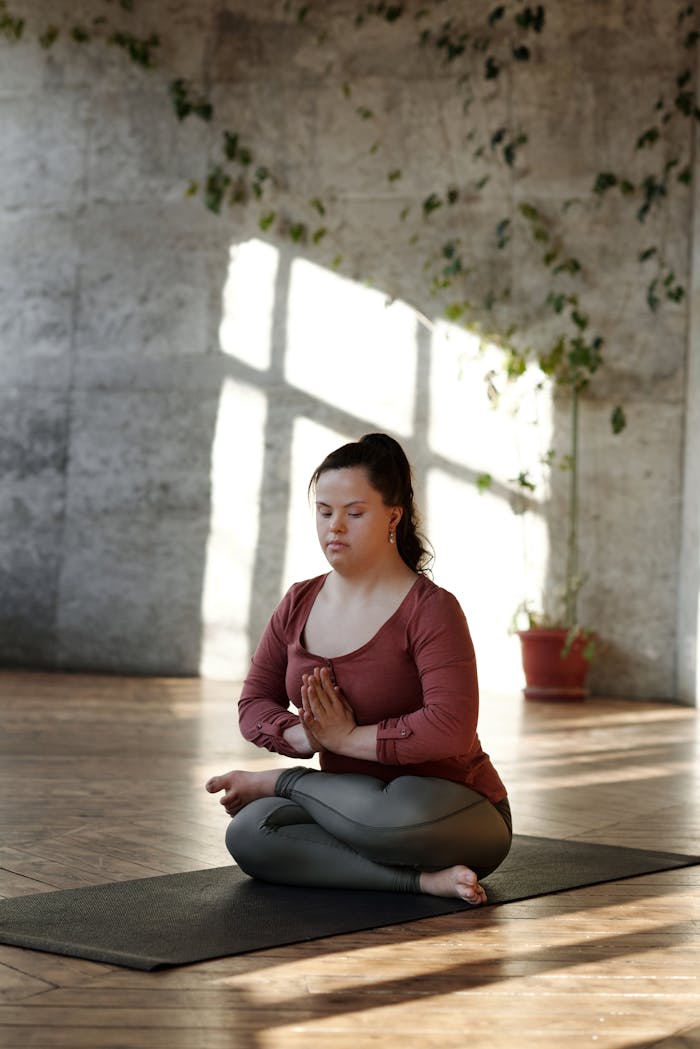
Bhakti Yoga is the path of devotion, love, and sacred connection. It is a way of living where the heart becomes a bridge between the human and the Divine. In Sanskrit, bhakti comes from the root bhaj, meaning “to share,” “to serve,” or “to participate in love.” Yoga means “union” or “connection.” So Bhakti Yoga can be understood as the yoga of loving union.
This path welcomes everyone.
You do not need to be a scholar, a monk, or someone with perfect habits. You do not need to belong to a particular culture, religion, or spiritual tradition. Bhakti begins wherever you are—with one sincere breath, one humble prayer, one moment of gratitude, one offering of love.
In a world where many people feel lonely, distracted, or spiritually thirsty, Bhakti Yoga offers a simple and profound reminder: you are not separate from love. You are held by something greater than the mind can fully understand. Through devotion, the heart learns to trust, soften, and remember its sacred nature.
What Is Bhakti Yoga?
The Yoga of Devotion
Bhakti Yoga is one of the main paths of yoga described in the wisdom traditions of India. While many people today associate yoga with physical postures, or asana, the deeper meaning of yoga is union—union with the Divine, with truth, with the soul, and with all beings.
Bhakti Yoga focuses on devotion. This devotion may be directed toward God, the Divine Mother, Krishna, Shiva, Jesus, Allah, the formless Absolute, the inner Self, nature, or simply the sacred presence of love itself. The form is less important than the sincerity of the heart.
In the Bhagavad Gita, one of yoga’s most beloved scriptures, Sri Krishna says:
“Whoever offers Me with devotion a leaf, a flower, a fruit, or water, I accept that loving offering from the pure-hearted one.”
— Bhagavad Gita 9.26
This verse beautifully reveals the spirit of Bhakti Yoga. The Divine is not asking for wealth, status, or outer perfection. A simple leaf offered with love is enough. The heart behind the offering matters more than the offering itself.
Bhakti as Relationship
Bhakti Yoga sees spiritual life as a relationship. This relationship may be felt as friendship, service, parent and child, beloved and lover, student and teacher, or soul and Source. Through this relationship, the practitioner develops intimacy with the sacred.
This is not a relationship based on fear. It is based on trust, tenderness, surrender, and love.
In Bhakti Yoga, the Divine is not distant. The Divine is near—within the heart, within breath, within the eyes of others, within the earth, within silence, and within daily life.
Devotion Is Not Blind Belief
Sometimes people misunderstand devotion as blind belief. But true bhakti is not about losing intelligence or giving up personal responsibility. It is a deepening of the heart.
Bhakti invites us to ask:
What do I truly love?
What do I serve with my time and energy?
What do I return to when life is difficult?
Where do I place my trust?
Devotion already exists in everyone. We are all devoted to something—work, family, success, comfort, healing, beauty, justice, freedom, or truth. Bhakti Yoga gently redirects devotion toward what is sacred, lasting, and life-giving.
Why Bhakti Yoga Matters Today
Healing the Loneliness of the Modern Heart
Many people today carry silent loneliness. Even with constant communication, social media, and busy lives, the heart can feel unseen. Bhakti Yoga meets this loneliness with connection.
When we chant, pray, serve, or sit quietly with love, we begin to feel that life is not empty. We are part of a greater whole. The sacred is not somewhere far away. It is present here, in this breath, in this moment.
Bhakti does not always remove life’s challenges. But it changes how we carry them. A burden held alone feels heavy. A burden offered to the Divine becomes part of a sacred journey.
Transforming Emotion Into Devotion
Bhakti Yoga honors emotion. Joy, grief, longing, gratitude, confusion, and even doubt can become part of the path.
Rather than suppressing feelings, Bhakti teaches us to offer them. Tears can become prayer. Longing can become a doorway. Love can become worship. Pain can become compassion.
The great bhakti saints often sang from the depths of human feeling. Mirabai, a beloved poet-saint devoted to Krishna, expressed longing, love, and surrender through song. Her life reminds us that the heart’s ache can become a sacred flame.
In practical terms, this means you do not have to wait until you feel peaceful to practice. You can come as you are.
Awakening Humility and Compassion
The practice of devotion softens the ego—the part of us that wants to control, compare, and be superior. Bhakti Yoga does not humiliate us; it humbles us. There is a difference.
Humiliation makes us feel small and unworthy. Humility helps us remember that we are part of something vast and beautiful.
When the heart becomes humble, compassion grows naturally. We begin to see others not as obstacles or competitors, but as souls walking their own path. This vision can transform families, communities, workplaces, and the way we care for the world.
Creating Meaning in Daily Life
Bhakti Yoga makes ordinary life sacred. Cooking can become an offering. Work can become service. Parenting can become worship. Listening to a friend can become devotion. Caring for the body can become gratitude.
This is the practical power of Bhakti Yoga: it does not ask us to escape life. It teaches us to bring love into life.
Check out the latest yoga guides on yoga guides for helpful tips and advice.
How to Practice Bhakti Yoga in Daily Life
Begin With a Simple Intention
A sincere intention is a powerful beginning. Before starting your day, pause for a moment. Place a hand on your heart and silently say:
“May my thoughts, words, and actions today be guided by love.”
Or:
“May I remember the sacred in all I do.”
This small practice can shift the direction of your day. Bhakti Yoga grows through repetition, not pressure. A few moments of sincere remembrance can be more transformative than a long practice done mechanically.
Practice Japa: Repetition of a Sacred Name or Mantra
Japa means the repetition of a sacred sound, name, or mantra. A mantra is a word or phrase that protects and steadies the mind. It can be repeated aloud, whispered, or silently.
Some traditional mantras include:
Om Namah Shivaya — “I bow to the sacred presence of Shiva,” or “I honor the Divine within.”
Om Namo Bhagavate Vasudevaya — “I bow to the Divine who lives in all beings.”
Hare Krishna Hare Krishna, Krishna Krishna Hare Hare, Hare Rama Hare Rama, Rama Rama Hare Hare — a devotional mantra calling upon divine joy, love, and presence.
You may also use a prayer from your own tradition, such as “Lord, guide me,” “Peace be with all,” or “Thank you, Divine Source.”
The power is not only in the sound but in the loving attention you bring to it.
Create a Small Sacred Space
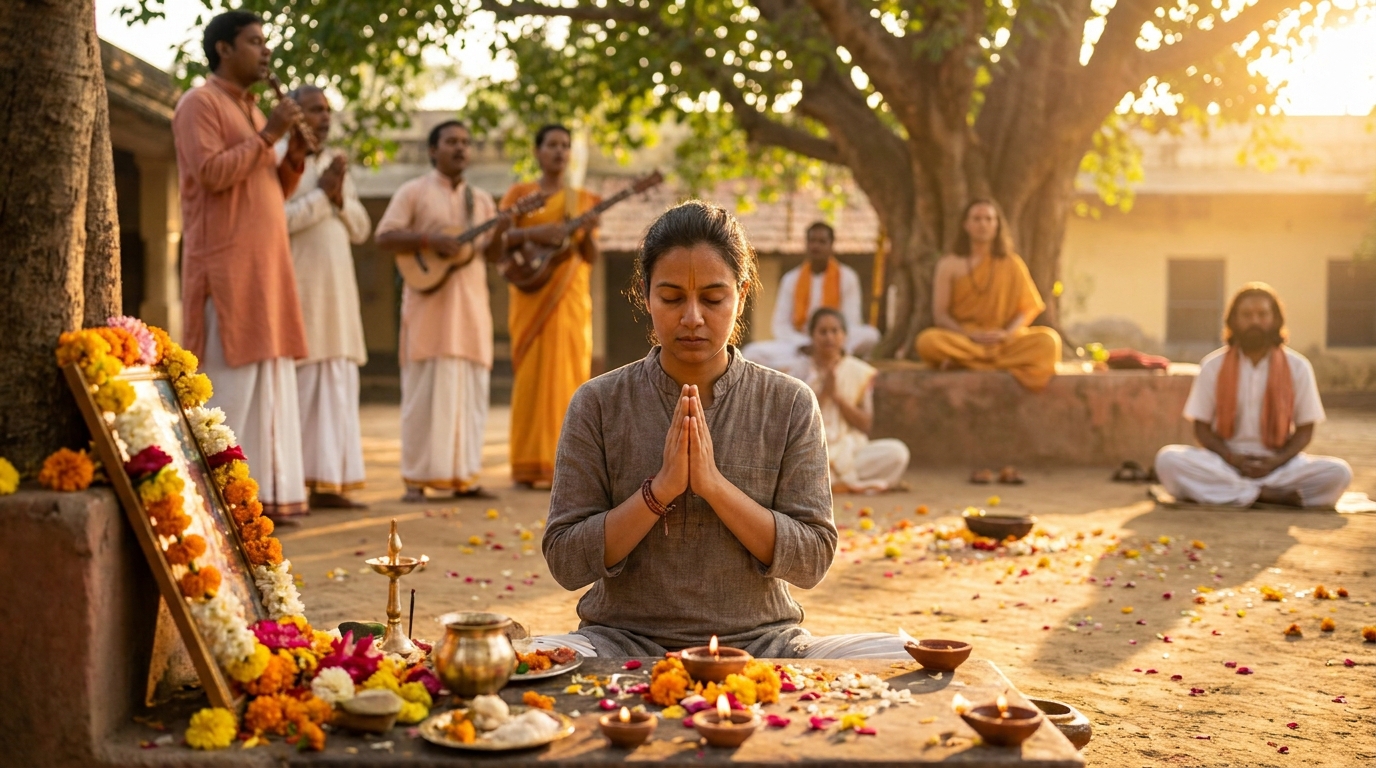
A home altar can support devotional practice. It does not need to be elaborate. You might include a candle, flowers, a picture of a teacher or sacred figure, a scripture, a stone, a bowl of water, or something from nature.
This space becomes a gentle reminder: pause, breathe, remember.
You can sit there for a few minutes each morning or evening. Offer gratitude. Chant. Read a verse. Sit in silence. Let the space be simple and alive.
Offer Your Food With Gratitude
In Bhakti Yoga, food can become prasada, which means “grace” or “blessed offering.” Before eating, pause and offer the meal inwardly:
“May this food nourish my body, mind, and heart. May I use this energy in service of love.”
This practice transforms eating from habit into sacred participation. It also cultivates gratitude for the earth, farmers, cooks, animals, plants, water, sunlight, and countless hands that bring food to the table.
Sing or Listen to Kirtan
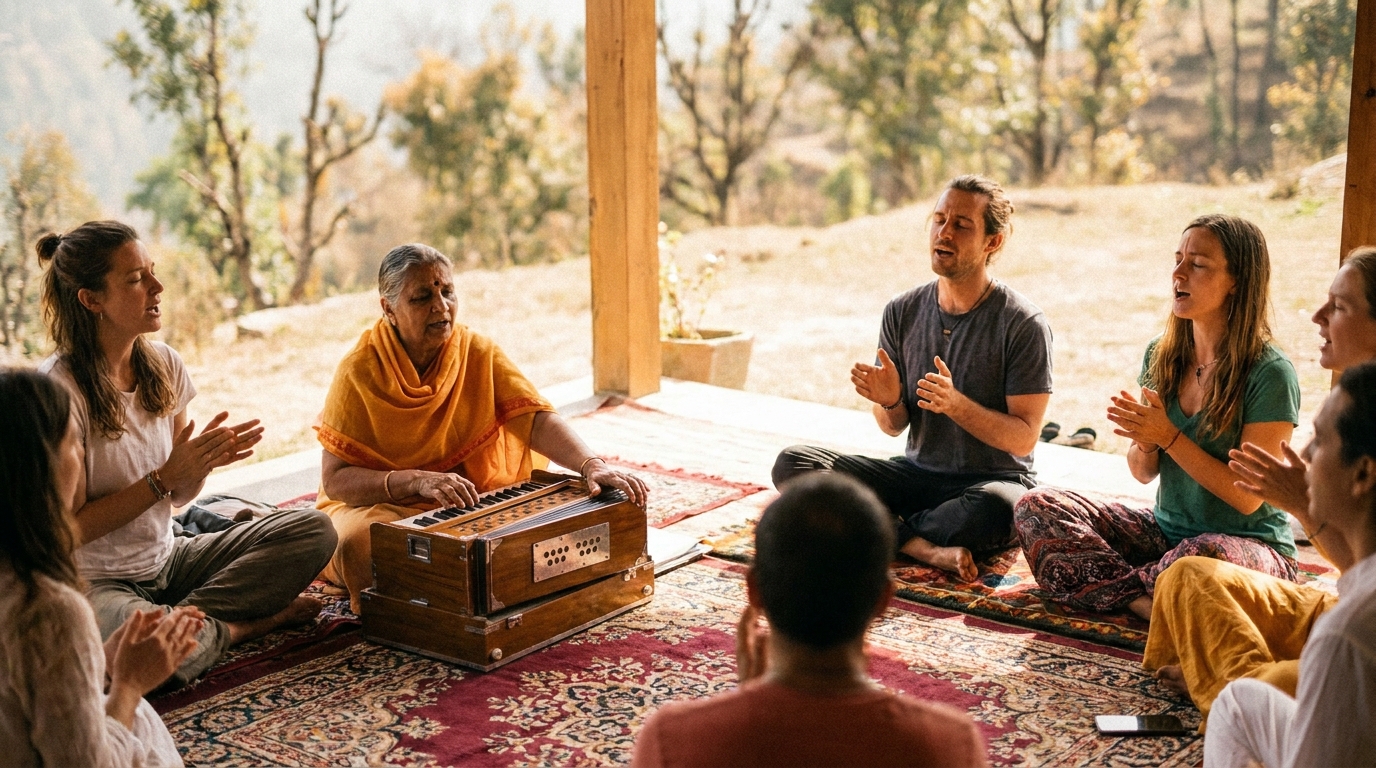
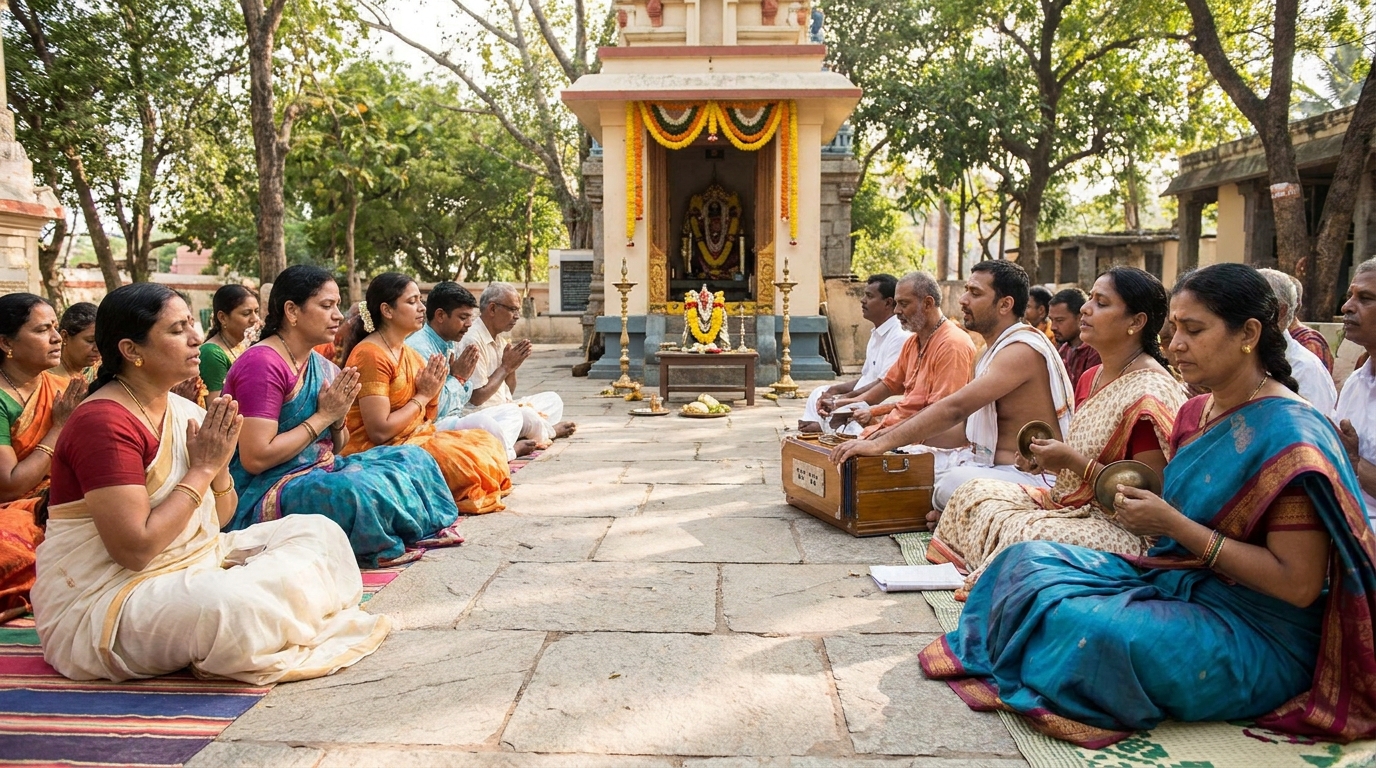
Kirtan is devotional chanting, often sung in a call-and-response style. It is a joyful and accessible practice of Bhakti Yoga. You do not need a trained voice. The purpose is not performance. The purpose is connection.
Through singing sacred names, the mind becomes focused and the heart opens. Many people experience kirtan as deeply healing because it allows emotions to move through sound.
If you are new to kirtan, you can listen quietly at first. Let the sounds wash over you. If you feel moved, sing along. If you feel shy, simply breathe and receive.
Serve Others as a Spiritual Practice
Seva means selfless service. It is love in action. In Bhakti Yoga, service is not about proving goodness. It is a way to honor the Divine in others.
Seva may look like volunteering, feeding someone, caring for a child, helping a neighbor, listening deeply, protecting nature, or doing your daily work with kindness.
The practice is to serve without clinging to praise or reward. This is not always easy. The ego likes recognition. But gradually, seva teaches the joy of giving for the sake of love itself.
The Wisdom of Bhakti in the Yoga Scriptures
Bhakti in the Bhagavad Gita
The Bhagavad Gita is a sacred dialogue between Krishna and Arjuna on the battlefield of life. Arjuna is confused, overwhelmed, and morally troubled. Krishna guides him through different paths of yoga, including Karma Yoga, Jnana Yoga, Dhyana Yoga, and Bhakti Yoga.
Karma Yoga is the yoga of selfless action.
Jnana Yoga is the yoga of wisdom and self-inquiry.
Dhyana Yoga is the yoga of meditation.
Bhakti Yoga is the yoga of devotion.
In chapter 12 of the Bhagavad Gita, Arjuna asks about the path of devotion. Krishna describes the qualities of a beloved devotee:
“One who has no hatred toward any being, who is friendly and compassionate, free from possessiveness and ego, balanced in pleasure and pain, and forgiving—that devotee is dear to Me.”
— Bhagavad Gita 12.13–14
This teaching makes Bhakti Yoga very practical. Devotion is not only what we feel during prayer or chanting. It is how we treat others. A devotional heart becomes kinder, steadier, less possessive, and more forgiving.
Bhakti in the Yoga Sutras
The Yoga Sutras of Patanjali are often associated with meditation and the eight limbs of yoga. Yet devotion also appears there through the teaching of Ishvara Pranidhana.
Ishvara means the Divine, the Supreme Being, or a special purusha—pure consciousness untouched by suffering. Pranidhana means surrender, dedication, or placing oneself before. So Ishvara Pranidhana means surrender to the Divine or dedication of one’s practice to the sacred.
Patanjali presents Ishvara Pranidhana as one of the niyamas, or personal observances, and also as a direct means toward samadhi, deep spiritual absorption.
Practically, this means we do our best, but we stop pretending we control everything. We practice sincerely and release the fruits of our actions.
Bhakti in the Narada Bhakti Sutra
The Narada Bhakti Sutra is a beloved text dedicated to the nature of devotion. It describes bhakti as supreme love for the Divine.
One of its teachings says that bhakti is “of the nature of nectar.” This means devotion nourishes the soul. It gives sweetness, depth, and meaning beyond temporary pleasure.
The text also emphasizes simplicity, sincerity, and wholeheartedness. Bhakti is not reserved for the spiritually elite. It is available to anyone whose heart longs for truth and love.
The Inner Attitudes of Bhakti Yoga
Surrender Without Giving Up
Surrender is a central word in Bhakti Yoga, but it can be misunderstood. Spiritual surrender does not mean becoming passive, weak, or careless. It means releasing the illusion that the small ego must control every outcome.
We still act. We still make wise choices. We still take responsibility. But we offer the results to the Divine.
This brings freedom. We are no longer crushed by success or failure. We become more available to serve, learn, and grow.
A simple daily reflection is:
“I offer my effort. I release the outcome.”
Gratitude as a Doorway
Gratitude is one of the easiest ways to begin Bhakti Yoga. When the heart says “thank you,” it opens.
You might practice gratitude by writing three things each day that touched your heart. They do not need to be dramatic. Warm tea. A kind message. A bird’s song. A deep breath. A moment of patience.
Over time, gratitude trains the mind to notice grace. Life may still be difficult, but we begin to see blessings woven through the difficulty.
Longing as Sacred Fire
Many seekers feel longing—a deep ache for meaning, belonging, healing, or God. Bhakti Yoga honors longing as sacred. This longing is not a failure. It may be the soul remembering its Source.
Instead of distracting yourself from longing, you can sit with it gently. Place your hand on your heart and breathe. Let the longing become prayer:
“May this longing lead me home to love.”
The bhakti saints often spoke of longing as the thread that ties the soul to the Divine. It keeps the heart awake.
Seeing the Divine in All Beings
A mature bhakti practice expands love beyond one’s chosen image or form of the Divine. It teaches us to see sacredness in all beings.
This does not mean we lose discernment. We can set boundaries. We can say no. We can protect ourselves and others. But even with boundaries, we can remember that every being carries a spark of life.
This vision is deeply needed in today’s world. Bhakti Yoga can help heal divisions by reminding us that no one is outside the circle of sacred belonging.
Common Challenges on the Path of Devotion
“I Don’t Feel Devotional”
Many people worry that they are not emotional enough for Bhakti Yoga. But devotion is not always dramatic. It can be quiet, steady, and simple.
Washing dishes with gratitude can be bhakti. Showing up for meditation when the mind is restless can be bhakti. Apologizing with sincerity can be bhakti. Caring for the body with respect can be bhakti.
Feelings come and go. Sincerity is the foundation.
Doubt and Faith Can Coexist
Faith in Bhakti Yoga does not require the absence of doubt. Doubt can be part of an honest spiritual life. The key is not to let doubt harden the heart.
You can bring doubt into prayer:
“I do not fully understand, but I am willing to be guided.”
This humble willingness is itself devotion.
In many traditions, faith grows through experience. Practice first. Notice what happens. Does chanting soften the mind? Does service open the heart? Does gratitude bring peace? Let your own life become the laboratory.
Avoiding Spiritual Bypass
Bhakti Yoga is not a way to avoid pain, injustice, trauma, or responsibility. True devotion makes us more honest, not less.
If you are grieving, devotion does not demand that you pretend to be happy. If you are hurt, devotion does not ask you to ignore boundaries. If there is injustice, devotion does not mean silence.
Love must become courageous. Bhakti Yoga, when practiced deeply, gives strength to act with compassion and clarity.
Balancing Devotion With Wisdom
Devotion is powerful, and like all powerful things, it needs wisdom. A healthy Bhakti Yoga practice does not require surrendering your discernment to another person. Teachers, communities, and traditions can be beautiful supports, but no outer authority should demand that you ignore your conscience.
True bhakti increases humility, kindness, freedom, and inner steadiness. If a practice or relationship creates fear, dependency, or harm, it is wise to pause and seek guidance.
The heart of Bhakti Yoga is love, not control.
Bhakti Yoga as a Practical Path for Daily Life
Morning Practice: Begin With Remembrance
A simple morning Bhakti Yoga practice may take only five to fifteen minutes.
Sit comfortably.
Take three slow breaths.
Light a candle if you wish.
Offer gratitude for the new day.
Repeat a mantra or prayer 9, 27, or 108 times.
Dedicate your day to love and service.
If you have more time, you may read a verse from the Bhagavad Gita, sing a devotional song, or sit in silent meditation.
The key is consistency. A small daily practice done with sincerity can slowly reshape the heart.
During the Day: Turn Actions Into Offerings
Throughout the day, choose one or two actions to consciously offer.
Before sending an email, pause: “May my words be helpful.”
Before entering a meeting, pause: “May I listen with respect.”
Before caring for a child or elder, pause: “May this be an act of love.”
Before difficult conversations, pause: “May truth and compassion guide me.”
This is Bhakti Yoga in action. It brings sacred awareness into ordinary moments.
Evening Practice: Return Everything to the Divine
At night, take a few quiet moments to reflect.
What did I offer with love today?
Where did I forget?
Whom do I need to forgive?
Where do I need forgiveness?
What am I grateful for?
Then inwardly place the whole day at the feet of the Divine—your successes, mistakes, joys, frustrations, and unfinished tasks.
You might say:
“All that I did well, I offer. All that I did poorly, I offer. Please guide me again tomorrow.”
This practice brings humility and peace. It allows the heart to rest.
How Else Can Bhakti Yoga Deepen Your Spiritual Journey?
Bhakti and Meditation
Bhakti Yoga and meditation support each other beautifully. Devotion warms meditation, and meditation steadies devotion.
If meditation feels dry or difficult, begin with a devotional song, prayer, or gratitude practice. This can soften the mind and make silence more inviting.
If devotion feels emotionally overwhelming, silent meditation can bring grounding and balance.
Together, they help the practitioner develop both tenderness and clarity.
Bhakti and Hatha Yoga
Hatha Yoga is the path that works with the body, breath, and energy. When practiced with devotion, physical yoga becomes more than exercise. Each posture becomes an offering.
In a forward fold, you can practice humility.
In a backbend, you can practice openness.
In a balancing pose, you can practice trust.
In savasana, the final resting pose, you can practice surrender.
You do not need to force devotional feelings during yoga postures. Simply dedicate your practice:
“May this practice help me become more loving and aware.”
Bhakti and Karma Yoga
Bhakti Yoga and Karma Yoga are closely connected. Karma Yoga teaches selfless action without attachment to results. Bhakti Yoga fills that action with love.
Together, they form a powerful daily path:
Act with sincerity.
Serve with love.
Offer the results.
Keep the heart humble.
This is especially helpful for people with busy lives. You may not have hours for formal practice, but every action can become yoga when performed with awareness and devotion.
Bhakti in Interfaith and Universal Practice
Bhakti Yoga can be practiced in a way that honors many spiritual backgrounds. A Christian may practice bhakti through love of Christ. A Muslim may practice through remembrance of Allah. A Buddhist may express devotion to compassion and awakening. A person without religious identity may practice devotion through reverence for life, nature, truth, or love.
The outer language may differ, but the inner movement is similar: the heart bows to what is sacred.
This makes Bhakti Yoga deeply inclusive. It does not need to erase anyone’s tradition. It can deepen the sincerity of whatever path one already walks.
The Fruits of Bhakti Yoga
A Softer Heart
One of the first fruits of Bhakti Yoga is softness. The heart becomes less defended. We may become more easily moved by beauty, kindness, suffering, and grace.
This softness is not weakness. It is spiritual sensitivity. It allows love to flow more freely.
Greater Resilience
Devotion gives strength during hardship. When life does not go according to plan, bhakti offers a place to turn. Prayer, mantra, chanting, and surrender become inner refuges.
A person rooted in devotion may still feel pain, but they are not spiritually alone in their pain. They can lean into the Divine presence, trusting that even difficulty can become part of the path.
Freedom From Constant Self-Centeredness
Much suffering comes from being trapped in “me” and “mine.” Bhakti Yoga gently widens our identity. We begin to live not only for personal gain but for love, service, and sacred connection.
This brings joy. The heart was not made to live only for itself. It expands through giving.
Love Without Possession
Human love often becomes mixed with fear, control, and attachment. Bhakti Yoga purifies love. It teaches us to love more freely, without needing to possess.
This does not mean becoming detached in a cold way. It means loving with trust. We learn to honor others as souls, not objects of our expectations.
A Living Sense of Connection
Perhaps the deepest fruit of Bhakti Yoga is the felt sense of connection. The practitioner begins to experience that the Divine is not limited to temples, churches, mosques, altars, or meditation rooms. The sacred shines quietly through all of life.
A flower becomes a teaching.
A stranger becomes a reminder.
A difficulty becomes a doorway.
A breath becomes prayer.
A Simple Bhakti Yoga Practice to Begin Today
Step 1: Sit With Sincerity
Find a quiet place. Sit comfortably. You may close your eyes or keep them softly open. Let your body settle.
Take a few slow breaths. Feel the breath enter and leave. You do not need to make anything special happen.
Step 2: Place Your Hand on Your Heart
Bring one hand to the center of your chest. This area is often associated with the heart center, or anahata chakra. Anahata means “unstruck” or “unbroken.” It points to the deeper heart that remains whole beneath life’s wounds.
Feel warmth under your palm. Let this touch be gentle.
Step 3: Offer a Simple Prayer or Mantra
Choose words that feel honest. For example:
“May I be guided by love.”
“Thank you for this breath.”
“May all beings be safe and free.”
“Om Namah Shivaya.”
Repeat your chosen words slowly for a few minutes. If the mind wanders, return with kindness.
Step 4: Offer Someone Blessing
Bring to mind someone you love. Silently offer them peace.
Then bring to mind someone neutral, perhaps a neighbor or coworker. Offer them peace too.
If you feel ready, bring to mind someone difficult—not to excuse harm, but to free your heart from hatred. Offer a simple blessing:
“May you be guided toward wisdom and peace.”
If this feels too hard, return to blessing yourself. Bhakti Yoga should be honest, not forced.
Step 5: Dedicate Your Day
End with a dedication:
“May whatever goodness comes from this practice serve the well-being of all.”
This simple practice contains the essence of Bhakti Yoga: remembrance, love, offering, and connection.
Living the Power of Bhakti Yoga
Bhakti Yoga is not only a spiritual practice; it is a way of seeing. It invites us to live as if love is sacred, as if every being matters, as if the Divine is near, and as if our smallest actions can become offerings.
The power of Bhakti Yoga is not loud power. It is not the power of domination or achievement. It is the quiet power of a softened heart. The power to forgive. The power to keep loving. The power to serve without applause. The power to surrender what we cannot control. The power to remember, again and again, that we belong to the sacred.
For some, Bhakti Yoga begins with chanting. For others, with prayer. For others, with tears, gratitude, service, or silence. There is no single doorway. The heart has many ways of finding its way home.
Wherever you are, you can begin now.
Offer one breath.
Offer one thought.
Offer one act of kindness.
Offer one honest prayer.
In Bhakti Yoga, nothing sincere is too small. A leaf, a flower, a fruit, or a little water—offered with love—is enough. And perhaps, over time, we discover that the true offering is the heart itself.
FAQs
What is Bhakti Yoga?
Bhakti Yoga is a spiritual path in Hinduism that emphasizes the loving devotion to a personal god or goddess. It is one of the four main paths of yoga, alongside Karma Yoga, Jnana Yoga, and Raja Yoga.
What are the key practices of Bhakti Yoga?
The key practices of Bhakti Yoga include chanting, singing devotional songs (kirtan), prayer, meditation on the form of the deity, and selfless service (seva) performed in the spirit of devotion.
What are the benefits of practicing Bhakti Yoga?
Practicing Bhakti Yoga can lead to a deep sense of inner peace, love, and connection with the divine. It can also help individuals cultivate compassion, humility, and selflessness.
Who can practice Bhakti Yoga?
Bhakti Yoga is open to people of all backgrounds and does not require any specific religious affiliation. Anyone who seeks a path of love, devotion, and spiritual connection can practice Bhakti Yoga.
Are there any specific deities associated with Bhakti Yoga?
While Bhakti Yoga is open to devotion to any personal god or goddess, some of the most popular deities in Bhakti Yoga include Krishna, Radha, Rama, Sita, Shiva, and Durga.