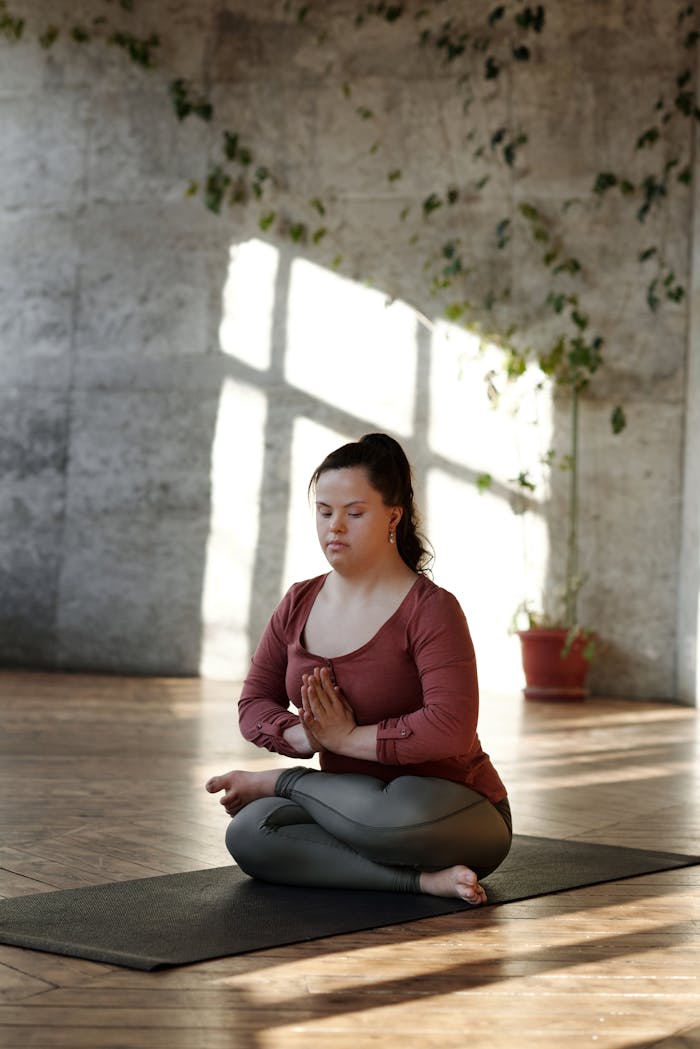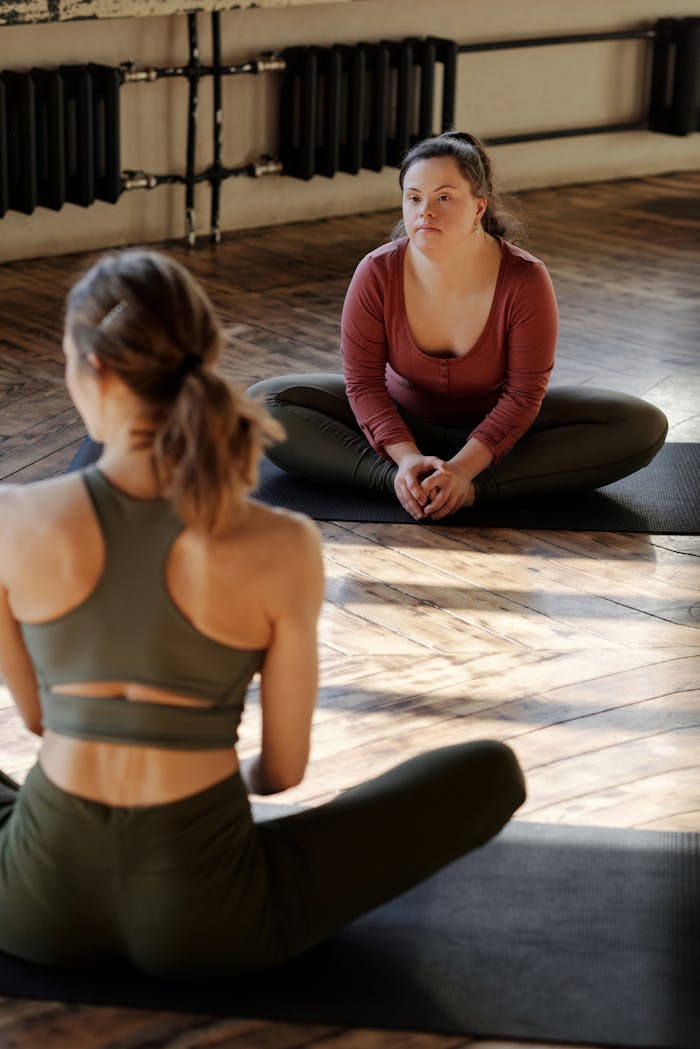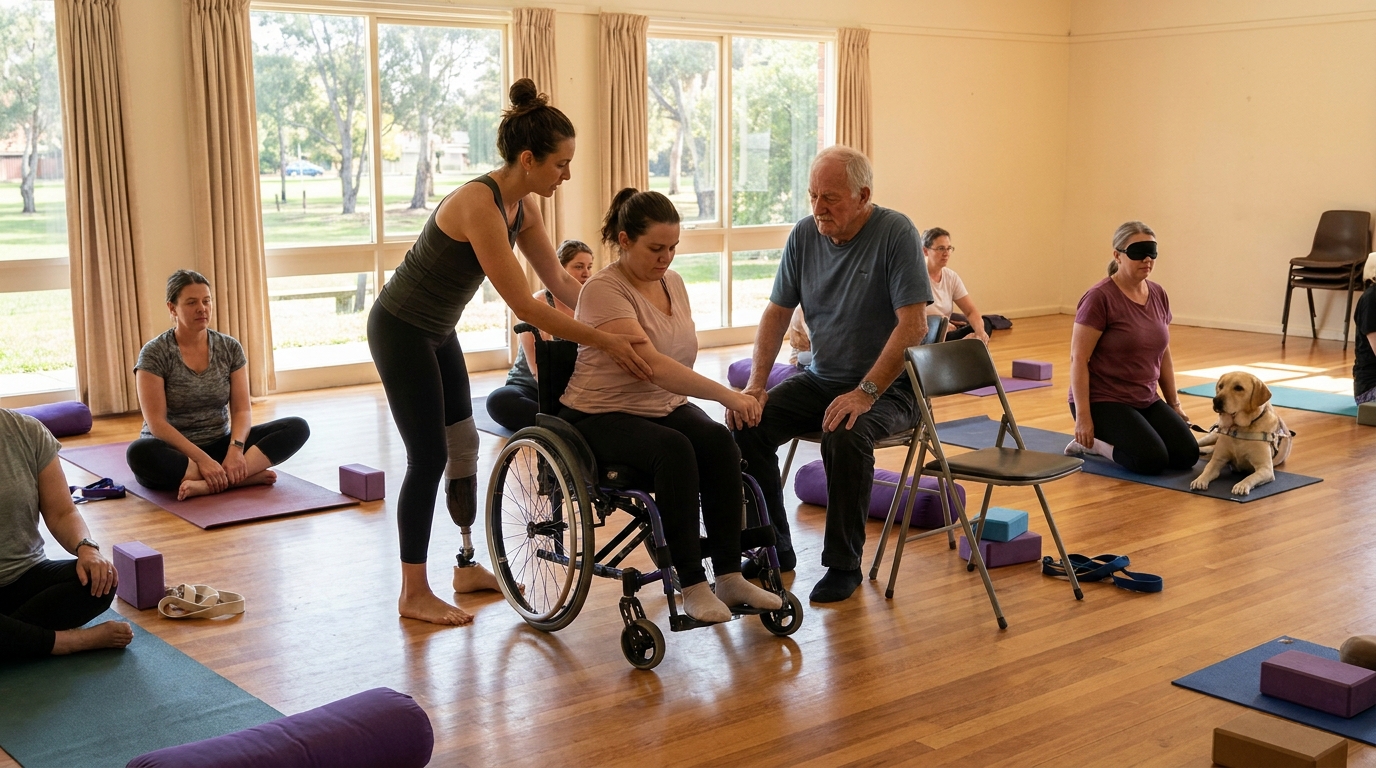
Adaptive yoga is the practice of making yoga accessible to each person, in each season of life, with the body, mind, and circumstances they have today.
It is not a “lesser” yoga. It is not only for people recovering from injury, living with disability, aging, or managing chronic illness—though it can be deeply supportive in all these situations. Adaptive yoga is for everyone, because every body is changing all the time.
In Sanskrit, the ancient language of yoga, the word yoga means “union” or “to yoke.” It points us toward connection: body and breath, effort and ease, the individual self and the sacred Whole. Adaptive yoga honors this meaning by inviting us to practice in a way that creates more connection, not more struggle.
A posture can be practiced standing, seated, lying down, with a chair, with the wall, with props, or even through visualization and breath. The outer shape may change, but the inner intention remains: awareness, steadiness, compassion, and devotion.
Yoga Is Not One Shape
Many people first meet yoga through images of flexible bodies in difficult poses. This can make yoga feel distant or even impossible. But the heart of yoga is not performance.
In the Yoga Sutras of Patanjali, one of the foundational texts of yoga, we find the teaching:
sthira sukham asanam — “Posture should be steady and comfortable.”
Yoga Sutras 2.46
This simple instruction is a beautiful doorway into adaptive yoga. A pose is not “correct” because it looks like a picture. It is beneficial when it supports steadiness (sthira) and ease (sukha) in the practitioner.
If a chair helps you feel steady, the chair is part of the yoga. If bending the knees helps your spine breathe, the bend is wisdom. If resting is what brings you closer to peace, rest is the practice.
Adaptive Yoga Meets You Where You Are
Adaptive yoga says: “Come as you are.”
Come with pain or energy. Come with uncertainty or confidence. Come with a body that moves freely, or a body that needs support. Come with a restless mind, a grieving heart, or a spirit longing for quiet.
In the path of bhakti—devotional yoga—we learn to approach life with humility and love. Adaptive yoga reflects this spirit. Rather than forcing the body into our ideas, we listen. Rather than conquering the body, we befriend it. Rather than comparing ourselves, we practice gratitude for the breath moving through us now.
This humble listening is yoga.
Why Adaptive Yoga Matters
Adaptive yoga matters because it restores dignity, choice, and belonging.
So many people quietly feel that yoga is not for them. Perhaps they think they are too old, too stiff, too large, too weak, too injured, too anxious, or not “spiritual enough.” Adaptive yoga gently removes these barriers. It reminds us that the practice belongs to all.
Yoga is not reserved for the strong. It helps us find strength. Yoga is not reserved for the calm. It helps us cultivate calm. Yoga is not reserved for the flexible. It helps us become more flexible in body, mind, and heart.
Balance Is More Than Standing on One Leg
When we speak of balance in adaptive yoga, we mean more than physical balance.
Yes, adaptive yoga can support balance in the body by improving coordination, joint awareness, core strength, and stability. This can be especially helpful for older adults, people recovering from injury, or anyone wanting to move with more confidence.
But balance also means emotional balance. It means learning when to act and when to rest. It means honoring both effort and surrender. It means becoming steady in the midst of change.
In the Bhagavad Gita, a beloved scripture of yoga, Krishna teaches Arjuna:
“Yoga is skill in action.”
Bhagavad Gita 2.50
This “skill” is not only technical ability. It is the wisdom to respond appropriately. Adaptive yoga teaches this skill through the body. We learn to ask: What is needed now? More support? More breath? More courage? More softness?
Strength Can Be Gentle
Strength in yoga is not only muscular power. It is also patience, resilience, and trust.
Adaptive yoga builds strength gradually. A person may strengthen the legs by rising from a chair with awareness. Another may strengthen the shoulders by pressing gently into a wall. Someone else may build inner strength by staying present with the breath during discomfort or anxiety.
In bhakti, strength is softened by devotion. We do not practice to prove our worth. We practice because this life is sacred. We practice as an offering.
This changes everything.
When practice becomes an offering, even a small movement becomes meaningful. Lifting the arms with breath can become a prayer. Sitting upright can become an act of respect for the body. Resting in stillness can become trust.
The Foundations of Adaptive Yoga Practice
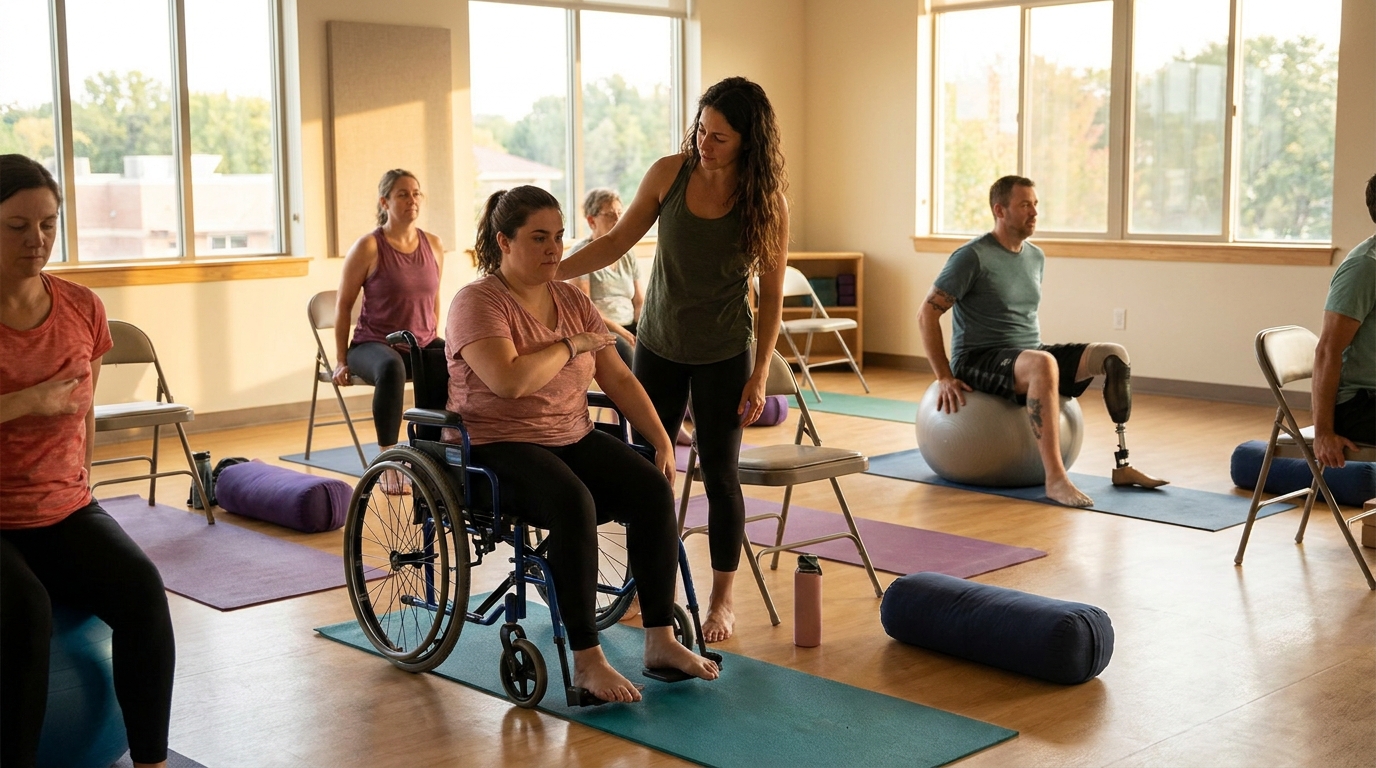
Adaptive yoga is rooted in awareness, compassion, safety, and choice. These foundations help make the practice sustainable and nourishing.
Awareness: Listening Before Moving
Before we move, we listen.
This is a simple but powerful principle. Pause and notice the body. Where is there comfort? Where is there tension? How is the breath? Is the mind scattered or settled?
In Sanskrit, svadhyaya means “self-study.” It is one of the niyamas, or personal observances, described in the Yoga Sutras. Self-study does not mean self-criticism. It means kind observation.
Adaptive yoga encourages this inner inquiry:
- What do I feel today?
- What support would help me?
- What movement feels possible?
- What would create steadiness and ease?
This kind of listening prevents injury and deepens the practice. It also helps us become more compassionate in daily life.
Compassion: Practicing Without Violence
Another important yogic principle is ahimsa, meaning “non-harming.” It is the first of the yamas, or ethical guidelines, in the Yoga Sutras.
In adaptive yoga, ahimsa begins with how we treat ourselves.
If a pose causes sharp pain, we stop or modify. If fatigue arises, we rest. If the breath becomes strained, we soften. This is not weakness. It is wisdom.
Many of us have learned to push through discomfort, ignore our limits, or compare our bodies to others. Adaptive yoga invites a different way: one of respect.
The body is not an obstacle to spiritual life. It is a temple, a living place of practice. We care for it not out of vanity, but out of reverence.
Choice: Empowering the Practitioner
Adaptive yoga offers options. This is essential.
A teacher may offer several variations of a pose, but the practitioner remains the final authority on their own body. This is especially important for people who have experienced trauma, illness, medical procedures, disability, or loss of physical independence.
Choice restores agency.
You may choose to practice with eyes open or closed. You may choose a chair or the floor. You may choose movement or stillness. You may choose to stop.
A truly adaptive yoga environment does not shame these choices. It honors them.
Check out the latest yoga guides on yoga guides for helpful tips and advice.
How to Practice Adaptive Yoga for Balance and Strength
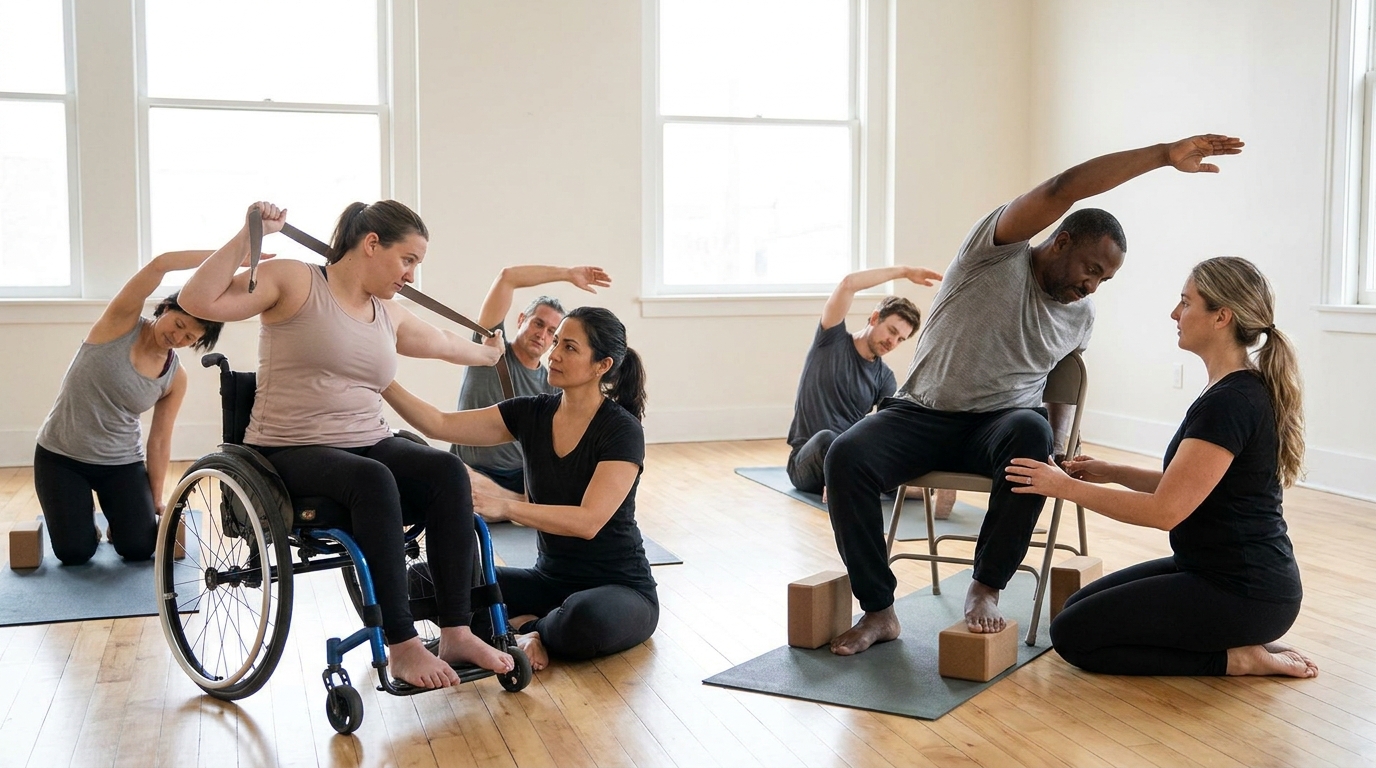
Adaptive yoga can be practiced at home, in a studio, in a chair, beside a bed, or even in a hospital or workplace. The key is to begin simply and safely.
If you have a medical condition, recent surgery, serious balance concerns, or chronic pain, please consult a qualified healthcare professional and, when possible, work with a trained adaptive yoga teacher or yoga therapist.
Begin With Breath Awareness
Breath is the most accessible doorway into yoga.
In Sanskrit, prana means “life force” or vital energy. Pranayama is the practice of working with the breath to guide this energy. In adaptive yoga, breath practices should be gentle and never forced.
Try this simple practice:
Sit comfortably in a chair, on a cushion, or lie down. Let your hands rest wherever they feel supported. Notice the natural breath.
Feel the inhale arrive. Feel the exhale release.
You do not need to breathe perfectly. Simply receive the breath.
After a few moments, you may gently lengthen the exhale. For example, inhale for a count of three and exhale for a count of four. If counting creates stress, let it go and simply feel the breath.
This practice can calm the nervous system, improve focus, and prepare the body for movement.
Seated Mountain Pose for Postural Strength
Mountain Pose is called Tadasana in Sanskrit. Tada means “mountain.” It is often practiced standing, but it can be beautifully adapted to a chair.
Sit toward the front of a sturdy chair with feet on the floor, hip-width apart if possible. If the feet do not reach the floor, place blocks, books, or a folded blanket underneath them.
Feel the sitting bones rooting into the chair. Gently lengthen through the spine. Let the shoulders soften. Imagine the crown of the head rising like a mountain peak.
Take five slow breaths.
This simple posture builds awareness of alignment and supports spinal strength. It can also bring a sense of dignity and groundedness.
You might silently repeat: “I am supported. I am steady.”
Chair Cat-Cow for Spinal Mobility
Cat-Cow is often practiced on hands and knees, but chair Cat-Cow is a wonderful option for many bodies.
Sit upright with hands resting on thighs.
As you inhale, gently lift the chest and draw the shoulders back. Let the heart space open.
As you exhale, round the spine slightly, drawing the navel gently inward and softening the chin toward the chest.
Move slowly with the breath for 5 to 8 rounds.
This movement can reduce stiffness in the back, encourage breath awareness, and support gentle mobility.
Avoid forcing the range of motion. Let the spine move like a small wave.
Supported Warrior for Leg Strength
Warrior poses are known as Virabhadrasana. In mythology, Virabhadra was a powerful warrior. In yoga, the warrior reminds us of courage—not aggression, but the courage to stand in truth.
For an adaptive supported Warrior II, stand beside a wall or behind a chair.
Step one foot back comfortably. Turn the back foot slightly outward if that feels stable. Bend the front knee a little, keeping it aligned toward the toes. Hold the chair or wall for support.
You may keep the hands on the chair, or extend one or both arms if steady.
Breathe for 3 to 5 breaths, then change sides.
This posture can strengthen the legs, improve balance, and cultivate confidence. If standing is not appropriate, practice a seated version: sit tall, widen the knees if comfortable, and extend the arms gently to the sides.
The spirit of the pose is what matters: grounded courage.
Heel Raises for Balance and Ankle Strength
Stand behind a chair with both hands resting lightly on the back of it. Keep the feet hip-width apart.
As you inhale, slowly lift the heels. As you exhale, lower them with control.
Repeat 5 to 10 times.
This simple movement strengthens the calves and ankles, supports circulation, and improves balance confidence. It can also be done seated by lifting and lowering the heels while the toes remain on the floor.
Move slowly. Let the chair support you. There is no need to rush.
Supported Tree Pose for Steady Balance
Tree Pose is called Vrksasana. Vrksa means “tree.” A tree is both rooted and reaching—an image of balanced strength.
Stand near a wall or hold a chair.
Shift weight gently into one foot. Keep the toes of the other foot on the floor and turn the knee slightly outward if comfortable. The lifted foot may rest at the ankle, calf, or remain like a kickstand on the floor. Avoid pressing into the knee joint.
Bring one hand to the heart, or keep both hands on support.
Take 3 slow breaths. Then change sides.
If standing balance is not accessible, practice seated Tree Pose. Sit tall, place one foot slightly outward, and bring hands to the heart or rest them on the thighs.
Balance is not about never wobbling. Trees move in the wind. Wobbling can be part of learning.
Rest as a Strength Practice
At the end of practice, rest.
This may be in a chair, lying on the back, lying on the side, or reclining with pillows. In yoga, deep rest is often practiced in Savasana, meaning “Corpse Pose.” The name may sound unusual, but it points to surrender: letting go of effort and resting in being.
If lying down is uncomfortable, sit supported. Cover yourself with a blanket if warmth feels good. Let the eyes soften. Feel the breath.
Rest for 3 to 10 minutes.
In our busy world, rest is a sacred act. It teaches the nervous system safety. It allows the fruits of practice to settle.
Adapting Yoga With Props and Support
Props are not signs of limitation. They are tools of wisdom.
A block, strap, wall, chair, cushion, blanket, or bolster can make yoga more accessible, stable, and enjoyable. In adaptive yoga, props help the body receive the posture rather than fight for it.
Using a Chair in Adaptive Yoga
A chair can support seated, standing, and balancing practices.
Choose a sturdy chair without wheels. If possible, use one with a flat seat and no armrests, though armrests can also be helpful for some practitioners.
Chair yoga can include:
- Seated breathing
- Gentle spinal movements
- Shoulder rolls
- Seated twists
- Leg extensions
- Supported standing poses
- Balance practice
Chair yoga is especially helpful for people with limited mobility, fatigue, dizziness, joint pain, or difficulty getting up and down from the floor. It can also be useful in offices, community centers, and caregiving settings.
Using the Wall for Stability
The wall is a quiet teacher. It offers feedback and support.
You can practice Mountain Pose with your back near the wall, noticing posture. You can place hands on the wall for a supported Downward-Facing Dog variation. You can use the wall in balance poses to reduce fear of falling.
Fear can tighten the body. Support helps the nervous system soften. When the body feels safer, strength can develop more naturally.
Using Blankets, Cushions, and Bolsters
Soft props bring comfort and grounding.
A folded blanket can support the knees. A cushion can lift the hips in seated meditation. A bolster can support the back in reclining poses. A rolled towel can support the neck or ankles.
Small adjustments often make a big difference.
In adaptive yoga, comfort is not indulgence. Comfort helps the body settle. When the body settles, the mind can turn inward.
Adaptive Yoga for Different Needs and Life Seasons
Every practitioner is unique. Adaptive yoga respects this uniqueness.
The same pose may need to look different for different people. Even for the same person, the practice may change from day to day.
Adaptive Yoga for Older Adults
For older adults, adaptive yoga can support balance, mobility, joint health, posture, breath capacity, and confidence in movement.
Chair-based practices, wall support, slow transitions, and balance training can be especially helpful. Practices should include time for warming up, moving gradually, and resting.
But older adulthood is not only a time of physical adjustment. It can also be a time of deep wisdom. Yoga offers space to honor life experience, grief, gratitude, and spiritual reflection.
A simple practice of breath, gentle movement, and devotional remembrance can be profoundly nourishing.
Adaptive Yoga for Chronic Pain
People living with chronic pain often need a compassionate, nervous-system-informed approach.
The goal is not to “fix” the body through force. The goal is to create moments of safety, awareness, and choice.
Gentle breathing, small movements, supported rest, and pacing are important. Instead of asking, “How far can I go?” we may ask, “What helps me feel safe and present?”
Some days, practice may be only five minutes. This still counts.
Yoga teaches consistency, not perfection.
Adaptive Yoga for Disability
Adaptive yoga can support people with many types of disabilities, including mobility differences, neurological conditions, sensory differences, limb differences, visual impairment, and more.
A respectful approach begins by asking the practitioner what support they prefer. Teachers should avoid assumptions. The person is not a problem to be solved; they are a whole being to be honored.
The inner limbs of yoga—breath, concentration, meditation, devotion, ethical living—are available in countless ways. Movement is only one doorway.
A person can practice yoga through breath, mantra, visualization, mudra, meditation, or mindful daily action.
Adaptive Yoga for Stress and Anxiety
Stress and anxiety often live in the body as tension, shallow breathing, restlessness, or fatigue. Adaptive yoga can help by offering gentle structure.
Slow exhalations, supported forward folds, grounding poses, and restorative rest may calm the nervous system. However, some people feel uncomfortable with stillness or eyes closed. Adaptive practice allows options.
You might keep the eyes open. You might sit near a wall. You might choose movement before rest.
The goal is not to force calm. The goal is to create conditions where calm may naturally arise.
The Inner Practice: Bhakti, Breath, and Balance
Adaptive yoga is not only physical exercise. It can be a devotional practice, a way of remembering the sacred in everyday life.
Bhakti yoga is the path of love and devotion. It teaches that the heart can turn toward the Divine through song, prayer, service, remembrance, and surrender. The Divine may be understood in many ways: as God, Krishna, the Source, Love, Truth, or the sacred presence within all beings.
Readers of all backgrounds are welcome here. You do not need to adopt a particular belief to practice with reverence. You may simply bring sincerity.
Practicing With an Offering
In Sanskrit, Ishvara pranidhana means “surrender to the Divine” or “offering oneself to a higher reality.” It is another teaching from the Yoga Sutras.
In practical terms, this can mean dedicating your practice.
Before beginning, pause and say inwardly:
“May this practice bring steadiness and peace.”
“May this breath serve healing.”
“May the strength I cultivate benefit others.”
“May I practice with humility and love.”
This transforms yoga from self-improvement into sacred relationship.
Mantra as Gentle Support
A mantra is a sacred sound, word, or phrase used to steady the mind. One simple mantra is Om, often understood as the primordial sound or vibration of wholeness.
Another gentle mantra from the bhakti tradition is:
Lokah samastah sukhino bhavantu
“May all beings everywhere be happy and free.”
You may repeat this silently during breath practice or rest. If Sanskrit does not feel familiar, use English. The heart of mantra is sincere remembrance.
Finding Balance Between Effort and Surrender
The Bhagavad Gita offers a beautiful teaching about balance:
“Yoga is not for one who eats too much or too little, sleeps too much or too little.”
Bhagavad Gita 6.16, paraphrased
Krishna points toward moderation. Yoga is a balanced path.
Adaptive yoga lives this teaching. It asks us to avoid extremes: not forcing, not collapsing; not striving, not giving up. We practice with appropriate effort and humble surrender.
This balance is called into every pose and every breath.
How Else Can Adaptive Yoga Support Daily Life?
The gifts of adaptive yoga do not end when the mat is rolled up. The real practice continues in daily living.
Yoga becomes the way we sit, stand, breathe, speak, rest, and relate. It becomes the way we meet challenge with a little more steadiness and a little more kindness.
Mindful Transitions
Many injuries and falls happen during transitions: getting up from a chair, turning quickly, stepping onto stairs, or reaching for something.
Adaptive yoga teaches mindful transitions.
When rising from a chair, feel the feet. Lean slightly forward. Use the legs. Press into the chair if needed. Stand slowly. Pause before walking.
This is yoga in action.
The same awareness can support getting in and out of bed, entering a car, lifting groceries, or moving through a busy room.
Breath During Difficult Moments
When life becomes stressful, the breath is always near.
You can practice one conscious breath before answering a difficult message. You can lengthen the exhale while waiting at a medical appointment. You can place a hand on the heart before speaking.
These small practices create space.
The more we practice in quiet moments, the more available these tools become in difficult moments.
Strength for Service
In bhakti, personal strength is not only for personal gain. It becomes a way to serve.
When we cultivate balance, we may move through the world with more care. When we build strength, we may support our families and communities. When we learn compassion toward our own body, we may become gentler with others.
This is the fragrance of yoga: inner practice becoming outer kindness.
Restoring a Loving Relationship With the Body
Many people carry pain, shame, frustration, or disappointment about the body. Adaptive yoga offers a slow healing of this relationship.
Instead of asking the body to be different, we begin to ask how we can care for it.
This does not mean we stop growing. It means growth is rooted in love rather than rejection.
The body may have limitations, but it is not a failure. It is a faithful companion on the path.
A Simple Adaptive Yoga Sequence for Balance and Strength
Here is a gentle practice you can try. Move slowly, and adjust as needed. Stop if you feel pain, dizziness, or distress.
1. Seated Centering
Sit comfortably in a chair. Feel the feet supported. Rest the hands on the thighs or heart.
Take 5 slow breaths.
Set an intention: “May I practice with steadiness and kindness.”
2. Shoulder Rolls
Inhale and lift the shoulders gently toward the ears. Exhale and roll them back and down.
Repeat 5 times, then reverse the direction.
3. Chair Cat-Cow
Place hands on thighs. Inhale, lift the chest slightly. Exhale, round the spine gently.
Repeat 5 to 8 rounds.
4. Seated Knee Lifts
Hold the sides of the chair if helpful. Inhale to sit tall. Exhale and lift one knee slightly, then lower.
Alternate sides 5 times each.
This supports hip flexor and core strength.
5. Sit-to-Stand Practice
From the chair, place feet firmly on the floor. Lean forward slightly. Press through the feet and rise to standing, using hands if needed.
Slowly sit back down.
Repeat 3 to 5 times.
If this is too much, practice leaning forward and pressing into the feet without standing fully.
6. Supported Heel Raises
Stand behind the chair. Hold lightly. Lift the heels as you inhale. Lower as you exhale.
Repeat 5 to 10 times.
7. Supported Tree Pose
Hold the chair or wall. Shift weight into one foot. Let the other foot rest lightly like a kickstand.
Breathe for 3 breaths. Change sides.
8. Seated or Reclined Rest
Return to sitting, or lie down with support. Let the body rest.
Stay for 3 to 5 minutes.
Close with gratitude: “Thank you, body. Thank you, breath. May this practice be of benefit.”
Creating an Inclusive Adaptive Yoga Space
Whether you are a student, teacher, caregiver, or community leader, you can help make yoga more welcoming.
Use Welcoming Language
Words matter.
Instead of saying “full pose,” we can say “another variation.” Instead of “if you can’t do this,” we can say “you might choose this option.” Instead of praising only flexibility or intensity, we can honor awareness, breath, and wise choices.
Inclusive language helps people feel respected.
Avoid Assumptions
Not all disabilities are visible. Not all pain is obvious. Not all strong-looking bodies feel strong. Not all older adults need the same support.
Ask rather than assume.
A humble teacher remains a student. A humble practitioner listens inwardly.
Celebrate Many Expressions of Yoga
Yoga may look like a person standing in Warrior Pose. It may look like someone breathing quietly in a chair. It may look like a caregiver practicing one mindful exhale. It may look like a person in bed repeating a mantra with devotion.
All of these can be yoga.
When the intention is sincere, the practice is alive.
Walking the Path With Humility
Adaptive yoga teaches us that balance and strength are not fixed achievements. They are living qualities, cultivated breath by breath.
Some days we feel stable. Some days we wobble. Some days we move with confidence. Some days we need rest. Through it all, yoga invites us to remain present.
The path is not about becoming someone else. It is about meeting ourselves honestly and lovingly, while remembering the deeper presence that holds us.
In the spirit of bhakti, we bow to the wisdom within every body. We bow to the teachers who preserved these practices. We bow to the breath that continues to guide us. We bow to the sacred possibility that, even in limitation, love can expand.
Adaptive yoga reminds us: you do not need to be perfect to practice. You do not need to be flexible to belong. You do not need to be fearless to begin.
Begin where you are.
With one breath.
With one supported movement.
With one humble offering.
There, balance begins. There, strength awakens. There, yoga is already present.
FAQs
What is adaptive yoga?
Adaptive yoga is a modified form of yoga that is designed to accommodate individuals with physical limitations, disabilities, or other health concerns. It focuses on making yoga accessible to everyone, regardless of their abilities.
How is adaptive yoga different from traditional yoga?
Adaptive yoga incorporates modifications and props to make the practice more accessible for individuals with physical limitations. It may also include variations of poses and sequences to accommodate different needs and abilities.
Who can benefit from adaptive yoga?
Adaptive yoga can benefit individuals with physical disabilities, chronic pain, injuries, seniors, pregnant women, and anyone looking for a more gentle and accessible approach to yoga. It can also be beneficial for those recovering from illness or surgery.
What are the benefits of adaptive yoga?
The benefits of adaptive yoga include improved flexibility, strength, balance, and relaxation. It can also help reduce stress, alleviate pain, and improve overall well-being. Additionally, adaptive yoga can help individuals feel more empowered and confident in their bodies.
Where can I find adaptive yoga classes?
Many yoga studios and community centers offer adaptive yoga classes. Additionally, there are online resources and videos available for individuals to practice adaptive yoga at home. It’s important to find a qualified instructor who has experience working with individuals with diverse abilities.