Acro Yoga is a playful, heart-opening practice that brings together yoga, acrobatics, and compassionate connection. At first glance, it may look like people flying through the air in amazing shapes. But at its deeper level, Acro Yoga is not about showing off. It is about trust, listening, steadiness, kindness, and shared joy.
Whether you are new to yoga, experienced in movement, curious about partner practice, or simply looking for a joyful way to connect with others, you are welcome here.
In the spirit of bhakti, the yoga of devotion, we approach this practice humbly. Bhakti reminds us that every breath, every movement, and every human connection can become an offering. We do not need to be perfect. We only need to be sincere.
Acro Yoga can help us remember something simple and beautiful: we are not meant to practice life alone.
What Is Acro Yoga?
Acro Yoga is a partner-based movement practice that blends three main elements:
- Yoga for breath, awareness, balance, and inner steadiness
- Acrobatics for strength, play, and creative movement
- Healing arts, often inspired by Thai massage, for relaxation, support, and compassionate touch
In a typical Acro Yoga practice, people work together in small groups. The main roles are the base, the flyer, and the spotter.
The Base
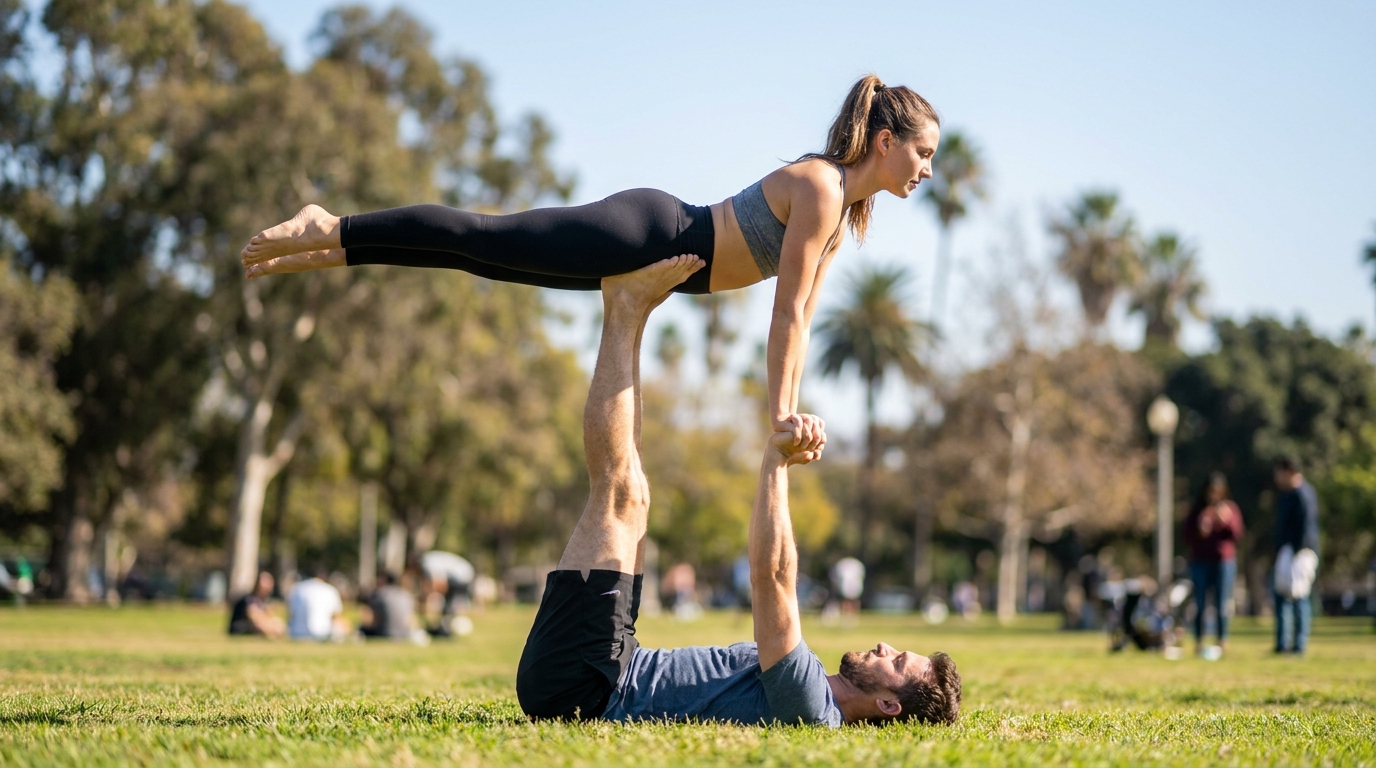
The base is usually the person supporting the flyer. Often, the base lies on the ground with their back on the mat and uses the strength of their legs and arms to hold the flyer.
The base teaches us about groundedness. In Sanskrit, the word sthira means steady or stable. A good base is not only physically strong but also calm, attentive, and responsive.
The Flyer
The flyer is the person being lifted or supported. The flyer may balance on the base’s feet, hands, or legs, moving through shapes that feel both graceful and empowering.
Flying is not about being fearless. It is about learning to trust wisely. The flyer practices awareness, body control, and surrender. In yoga, surrender is called Ishvara pranidhana, which means offering ourselves to something greater than our individual ego.
The Spotter
The spotter is the guardian of the practice. The spotter stands nearby to help prevent falls, guide alignment, and support communication between the base and flyer.
The spotter embodies seva, a Sanskrit word meaning selfless service. In Acro Yoga, spotting is not a lesser role. It is sacred work. A mindful spotter helps create safety, confidence, and trust.
Why Practice Acro Yoga?

Acro Yoga offers many benefits, but the deepest gift may be the way it softens the heart. In a world where many people feel isolated or rushed, Acro Yoga invites us to slow down, connect, and cooperate.
It teaches that strength does not have to be harsh. Play does not have to be careless. Trust does not have to be blind.
Acro Yoga Builds Trust
Trust is not something we demand from others. It is something we build gently, one breath and one clear communication at a time.
In Acro Yoga, trust grows through simple actions:
- Asking for consent before touching
- Listening to someone’s “yes,” “no,” or “not yet”
- Moving slowly
- Practicing with a spotter
- Speaking honestly about fear or uncertainty
This kind of trust can become a mirror for daily life. We learn to honor our own boundaries while respecting the boundaries of others.
Acro Yoga Encourages Playfulness
Many adults forget how to play. We become serious, busy, and careful. Acro Yoga gives us permission to laugh again.
Play is not childish. Play can be healing. When practiced safely and respectfully, play opens the mind, releases tension, and brings people into the present moment.
In the Bhagavad Gita, Lord Krishna encourages action with devotion and steadiness, without attachment to the results. This teaching can be beautifully applied to Acro Yoga. We practice not to impress others, but to be present. We try, fall, laugh, learn, and try again.
Acro Yoga Strengthens the Body
Acro Yoga can develop strength, flexibility, coordination, and balance. The base strengthens the legs, core, shoulders, and stabilizing muscles. The flyer builds body awareness, core strength, and confidence. The spotter develops attention, agility, and supportive presence.
Unlike some fitness practices that focus only on individual performance, Acro Yoga develops strength in relationship. We become strong together.
Acro Yoga Deepens Communication
Clear communication is essential in Acro Yoga. Before lifting someone, partners must discuss what they are doing, how they are feeling, and what support is needed.
Simple phrases become powerful tools:
- “Are you ready?”
- “I feel stable.”
- “Please come down.”
- “Can we pause?”
- “I need a spotter.”
- “Thank you.”
These words may seem ordinary, but they carry the spirit of mindfulness. They teach us to speak with care and listen with the whole body.
Sure, here is the sentence with the clickable link:
Check out the latest yoga guides at yoga guides.
The Yogic Heart of Acro Yoga

Although Acro Yoga is modern in its form, many of its deeper principles are rooted in ancient yoga wisdom. The physical shapes may be playful and new, but the inner teachings are timeless.
Yoga Means Union
The word yoga comes from the Sanskrit root yuj, meaning to unite or join. Yoga is often understood as union—union of body and mind, breath and movement, self and spirit.
In Acro Yoga, this sense of union becomes visible. Two or more people breathe, balance, and move together. The practice becomes a living reminder that harmony is possible when we listen deeply.
Ahimsa: Practicing Non-Harming
In the Yoga Sutras of Patanjali, one of the foundational teachings is ahimsa, which means non-harming. Ahimsa is not only about avoiding physical injury. It also means practicing kindness in thought, speech, and action.
In Acro Yoga, ahimsa means:
- Never forcing a pose
- Respecting personal limits
- Using a spotter when needed
- Being patient with beginners
- Avoiding comparison
- Speaking gently
- Coming down safely when something feels wrong
Ahimsa helps us remember that the person is more important than the pose.
Satya: Truthfulness in Practice
Another yogic principle is satya, meaning truthfulness. In Acro Yoga, satya invites honest communication.
If something feels unsafe, we say so. If we are tired, we admit it. If we do not understand a transition, we ask for help.
Truthfulness creates safety. It also builds real trust. Pretending to be confident when we are not ready can lead to harm. But humble honesty opens the door to learning.
Santosha: Contentment in the Journey
Santosha means contentment. It is the practice of being at peace with where we are.
In Acro Yoga, it is easy to look at advanced practitioners and feel discouraged. But every beautiful flow began with small steps. Every confident flyer was once learning how to balance. Every steady base was once discovering how to place their feet.
Santosha reminds us: this moment is enough. This breath is enough. This simple practice is worthy.
How to Begin Acro Yoga Safely
Acro Yoga is joyful, but it must be practiced with care. Safety is not separate from spirituality. Safety is an expression of love.
Before trying Acro Yoga, especially if you have injuries, medical concerns, or are pregnant, consider speaking with a qualified healthcare provider. It is also wise to learn from an experienced Acro Yoga teacher, especially in the beginning.
Start with Warm-Up and Breath
Begin with a gentle warm-up. The body should feel awake, warm, and responsive before any lifting or balancing.
A simple warm-up may include:
- Neck and shoulder rolls
- Cat-cow movements for the spine
- Gentle lunges
- Wrist stretches
- Downward-facing dog
- Core activation
- Partner breathing
Take a few moments to breathe together. In Sanskrit, breath practice is called pranayama. Prana means life energy, and ayama means expansion or regulation. Even three slow breaths can help partners become calm and present.
Learn the Basic Roles
Before attempting poses, make sure everyone understands the roles of base, flyer, and spotter.
The base should stay grounded and communicate clearly. The flyer should keep the body active and listen closely. The spotter should remain attentive, hands ready, and eyes focused.
No role is more important than another. Each role is a form of practice.
Use Clear Consent
Consent is essential in Acro Yoga. Always ask before touching, lifting, adjusting, or spotting someone.
A simple consent check may sound like:
“Would you like to try this pose together?”
“Is it okay if I place my hands here to spot you?”
“Do you feel ready to come up?”
“Would you like to stop?”
Consent should be ongoing. A person can change their mind at any time. Honoring that change is part of the practice.
Practice with a Spotter
Especially when learning, always use a spotter. The spotter helps protect the flyer, guide the base, and create a safer environment.
A good spotter does not distract, joke carelessly, or look away. The spotter stays present. This presence is a beautiful form of devotion.
Foundational Acro Yoga Poses for Beginners
Beginner Acro Yoga poses are simple, but they teach the essential skills needed for future practice. Move slowly. Communicate often. Come down before you become tired.
Partner Plank
Partner plank is a great way to build strength and trust.
One person comes into a strong plank position with hands on the ground. The second person places their hands on the ground and carefully places their feet on the first person’s upper back or hips, creating a stacked plank shape.
This pose teaches core engagement, stable shoulders, and teamwork.
Practice tip: Keep the breath steady. If either person feels strain, come down slowly.
Front Bird
Front Bird is one of the most common beginner Acro Yoga poses. The base lies on their back and places their feet on the flyer’s hip bones. The flyer leans forward, keeping the body active like a strong plank. The base gradually lifts the flyer into the air.
The flyer extends the arms out like wings, and the base supports through the legs.
This pose often brings a feeling of delight. But remember: joy grows best in safety. Use a spotter and communicate throughout.
Throne Pose
Throne pose allows the flyer to sit upright on the base’s feet, almost like sitting in a chair in the air.
The base lies on the back and places feet near the flyer’s upper thighs or seat. The flyer carefully transfers weight, and the base lifts. The flyer may place hands in prayer at the heart, known as anjali mudra. Mudra means gesture or seal, and anjali mudra is a gesture of respect and gratitude.
This pose can feel regal, but the attitude remains humble. We are supported by another person, by the earth, and by grace.
Folded Leaf
Folded Leaf is a gentle therapeutic Acro Yoga shape. The base supports the flyer, who folds forward and relaxes over the base’s feet. It can create a soft release for the back and nervous system.
This posture reminds us that Acro Yoga is not only about strength and flying. It is also about receiving support.
The flyer should breathe slowly. The base should remain attentive. The spotter should stay close.
How to Practice with Devotion and Humility
Acro Yoga can become a spiritual practice when we bring the right intention. The Sanskrit word bhava means feeling, mood, or inner attitude. Our bhava shapes the practice.
If we practice with ego, we may chase difficult poses and forget kindness. If we practice with devotion, even a simple partner stretch becomes sacred.
Begin with an Intention
Before practicing, take a moment to set an intention. It can be simple:
“May this practice bring trust.”
“May I listen with kindness.”
“May we practice safely.”
“May this movement be an offering.”
In bhakti yoga, devotion does not require a particular religious identity. It can be devotion to truth, love, compassion, God, the Divine, nature, or the sacredness of life. All sincere hearts are welcome.
Honor Your Partners
Your practice partners are not tools for achieving poses. They are human beings with feelings, fears, strengths, and limits.
Before and after each pose, offer gratitude. A simple “thank you” can carry deep spiritual power.
In the Bhagavad Gita, Krishna teaches the importance of seeing the Divine in all beings. In practical terms, this means we treat each person with dignity. We do not use people for our ambition. We practice together as souls sharing a journey.
Let Go of Performance
Acro Yoga is beautiful, and it is natural to enjoy the art of it. But the heart of the practice can become hidden if we focus only on photos, social media, or advanced tricks.
Ask yourself:
- Am I practicing to connect or to impress?
- Am I listening to my body?
- Am I respecting my partners?
- Am I willing to stay with the basics?
- Can I laugh when things do not go as planned?
Humility keeps joy alive.
Building Community Through Acro Yoga
One of the greatest blessings of Acro Yoga is sangha, a Sanskrit word meaning community or spiritual fellowship. Sangha reminds us that growth often happens in relationship.
A good Acro Yoga community is not based on competition. It is based on encouragement, safety, and shared learning.
Finding a Class or Jam
An Acro Yoga class is guided by a teacher. This is usually the best place to begin because you receive clear instruction, progressions, and safety guidance.
An Acro Yoga jam is a more informal gathering where people practice together. Jams can be joyful and inspiring, but beginners should still seek guidance and practice only what feels safe.
When looking for a class or community, notice the atmosphere. Do people welcome newcomers? Do they use spotters? Do they explain consent? Do they value safety over tricks?
A healthy community will never shame you for being new.
Practicing Inclusivity
Acro Yoga is for many kinds of bodies, ages, backgrounds, and experience levels. You do not need to look a certain way to begin. You do not need to be extremely flexible or already strong.
There are many ways to participate. Some people love flying. Some prefer basing. Some become excellent spotters. Some enjoy the therapeutic side. All are valuable.
A people-first Acro Yoga community makes space for different abilities, cultures, identities, and comfort levels.
The Joy of Shared Progress
In individual practice, progress can feel private. In Acro Yoga, progress is shared. When a flyer finds balance, the base celebrates. When a base becomes steadier, the flyer feels safer. When a spotter gives wise guidance, everyone benefits.
This shared success softens the ego. It teaches us that joy multiplies when offered freely.
Common Challenges and How to Meet Them
Acro Yoga can bring up fear, frustration, self-consciousness, and impatience. This is not a problem. It is part of the path.
Yoga does not ask us to avoid discomfort. It teaches us to meet discomfort with awareness and compassion.
Fear of Falling
Fear of falling is natural. Do not rush through it. Listen to it.
Use a spotter. Stay low to the ground. Practice simple shapes. Learn safe exits. Speak honestly.
Courage is not the absence of fear. Courage is moving with wisdom while respecting fear’s message.
Comparing Yourself to Others
Comparison can quietly steal joy. You may see advanced practitioners moving through beautiful flows and think, “I will never do that.”
Return to your breath. Everyone begins somewhere. Your practice does not need to look like anyone else’s.
The Yoga Sutras speak of abhyasa, steady practice over time. Growth comes through repetition, patience, and sincerity.
Difficulty Communicating
Some people find it hard to speak up. Acro Yoga can help develop this skill.
Start with simple phrases:
“Pause, please.”
“I need more support.”
“I feel nervous.”
“Can we try again more slowly?”
“I would like to come down.”
These words are not signs of weakness. They are signs of awareness.
Wanting to Advance Too Quickly
Advanced poses can be exciting, but rushing can lead to injury. Stay devoted to the foundations.
In yoga, discipline is called tapas. Tapas means heat, effort, or committed practice. True tapas is not aggressive. It is steady and wise. It helps us keep showing up with patience.
How Else Can Acro Yoga Enrich Your Life?
The lessons of Acro Yoga do not end when the practice session ends. They travel with us into relationships, work, family, and spiritual life.
Learning to Give and Receive
Many people are comfortable giving but uncomfortable receiving. Others may enjoy being supported but struggle to offer support. Acro Yoga invites balance.
Sometimes you are the base. Sometimes you are the flyer. Sometimes you are the spotter. Each role teaches a different kind of love.
To give support without control is a gift. To receive support without shame is also a gift.
Bringing Mindfulness into Relationships
Acro Yoga teaches practical relationship skills:
- Ask before assuming
- Listen before reacting
- Support without dominating
- Speak truth kindly
- Pause when needed
- Celebrate small victories
- Repair mistakes with humility
These lessons are valuable far beyond the mat.
Transforming Practice into Prayer
For those who feel connected to devotion, Acro Yoga can become a moving prayer.
Each lift can be an offering. Each breath can be gratitude. Each moment of trust can remind us of the unseen support that carries us through life.
For those who do not use the language of prayer, the same practice can be understood as presence, compassion, and mindful connection. The essence is open to all.
A Simple Acro Yoga Practice Sequence
Here is a gentle beginner-friendly structure for an Acro Yoga session. Practice with a qualified teacher when possible, and always prioritize safety.
1. Arrive and Breathe
Sit or stand with your partners. Take five slow breaths together. Notice the ground beneath you. Let the nervous system settle.
You may silently offer gratitude for the opportunity to practice.
2. Warm Up the Body
Move through gentle stretches and strengthening exercises. Include wrists, shoulders, hips, hamstrings, and core.
Keep the mood light but attentive.
3. Practice Communication
Before lifting, practice saying:
“Ready?”
“Ready.”
“Going up.”
“Pause.”
“Coming down.”
This may feel simple, but it creates a foundation of safety.
4. Try Foundational Poses
Choose one or two beginner poses such as Front Bird or Throne. Use a spotter. Repeat slowly, switching roles if appropriate.
Focus on quality, not quantity.
5. Include a Therapeutic Shape
End with a calming pose like Folded Leaf or a gentle partner stretch. Let the body receive rest.
6. Close with Gratitude
Gather together and say thank you. Notice what you learned. Celebrate effort, not perfection.
You may close with the Sanskrit word namaste, which is often understood as “the light in me honors the light in you.” Say it sincerely, or simply say, “Thank you for practicing with me.”
Practical Tips for a Joyful Acro Yoga Journey
Acro Yoga is both playful and profound. These simple tips can help keep your journey safe, humble, and joyful.
Choose Safety Over Ego
If a pose feels unsafe, come down. If you are tired, rest. If you need help, ask.
No pose is worth harming the body or breaking trust.
Practice the Basics Often
Foundational poses are not something to rush past. They are where strength, communication, and confidence are built.
Advanced practice is simply basic practice refined over time.
Keep Returning to the Breath
Breath is your anchor. If the breath becomes strained, the body may be overwhelmed. Pause and reconnect.
In yoga, breath and mind are deeply linked. A steady breath supports a steady mind.
Celebrate Small Moments
The first balanced lift. The first clear communication. The first time you feel safe flying. The first time you spot with confidence.
These moments matter. Honor them.
Stay Humble
Humility does not mean thinking poorly of yourself. It means remembering that we are always learning.
Every partner becomes a teacher. Every mistake becomes guidance. Every practice becomes an opportunity to serve love.
The Deeper Joy of Acro Yoga
The joy of Acro Yoga is not only in flying. It is in the moment someone says, “I’ve got you,” and means it. It is in the laughter after a wobbly attempt. It is in the courage to try again. It is in the quiet gratitude of being supported.
Acro Yoga reminds us that strength and softness can live together. Trust and boundaries can live together. Discipline and play can live together.
In this way, Acro Yoga becomes more than movement. It becomes a practice of relationship, devotion, and shared humanity.
May your Acro Yoga journey be safe, joyful, and kind. May you find good teachers, trustworthy partners, and a welcoming community. May your practice strengthen not only your body, but also your heart.
And may every flight, however small, remind you that life itself is supported by grace.
FAQs
What is Acro Yoga?
Acro Yoga is a physical practice that combines yoga and acrobatics. It typically involves two or more people working together to perform various poses and sequences.
What are the benefits of practicing Acro Yoga?
Practicing Acro Yoga can improve strength, flexibility, balance, and communication skills. It also promotes trust and connection between partners.
Is Acro Yoga suitable for beginners?
Yes, Acro Yoga can be modified to accommodate all levels of experience, including beginners. It is important to start with basic poses and gradually progress to more advanced ones.
What are the potential risks of practicing Acro Yoga?
As with any physical activity, there are potential risks involved in practicing Acro Yoga, such as muscle strains, falls, and overexertion. It is important to practice under the guidance of a qualified instructor and to communicate openly with your partner.
Where can I find Acro Yoga classes or workshops?
Acro Yoga classes and workshops are offered at yoga studios, fitness centers, and community centers around the world. Many instructors also offer online classes for those who prefer to practice at home.