Welcome, dear friend. Whether you are new to yoga, returning after many years, living with a stiff body, healing from injury, or simply longing for steadiness in a busy world, Iyengar Yoga offers a compassionate and practical doorway.
This method, developed by Yogacharya B.K.S. Iyengar, is known for precise alignment, mindful sequencing, and the thoughtful use of props such as blocks, belts, blankets, chairs, and bolsters. Yet beneath these visible tools is something very tender: a sincere invitation to know yourself more clearly.
In the spirit of bhakti—devotion, or loving dedication—Iyengar Yoga can become more than exercise. It can become a humble daily offering: to your body, to your breath, to your inner life, and to the Divine presence that many traditions recognize in different names and forms.
A practical method rooted in classical yoga
Iyengar Yoga is a form of hatha yoga. The Sanskrit word haṭha is often understood as the yoga of disciplined physical practice, using the body and breath as a path toward steadiness of mind. In Iyengar Yoga, postures are practiced with careful attention to alignment, timing, sequencing, and awareness.
B.K.S. Iyengar, one of the most influential yoga teachers of the modern era, brought great clarity to the practice of asana, meaning yoga posture. His approach made yoga accessible to people of many ages, body types, and physical conditions.
In Iyengar Yoga, the body is not forced into a shape. Rather, the posture becomes a place of learning. We enter it slowly. We observe. We adjust. We breathe. We listen.
This patient attention reflects a teaching from the Yoga Sutras of Patanjali, one of the foundational texts of yoga. In Yoga Sutra 2.46, Patanjali says:
“Sthira sukham asanam.”
This means that posture should be steady and easeful. Iyengar Yoga helps us understand this not as an abstract idea, but as a lived experience. The feet become steady. The spine becomes spacious. The breath becomes softer. The mind begins to settle.
The role of alignment
Alignment is one of the hallmarks of Iyengar Yoga. But alignment does not mean perfection. It means relationship.
How do the feet relate to the knees? How does the pelvis support the spine? How does the breath move through the ribs? How can the body become balanced without strain?
For example, in Tadasana, Mountain Pose, a student learns to stand with awareness. The feet spread evenly. The legs become active. The chest lifts without hardness. The head rests quietly above the spine.
To an outside observer, it may look like “just standing.” But within, a great education is happening. We are learning how to inhabit the body with dignity and care.
The use of props
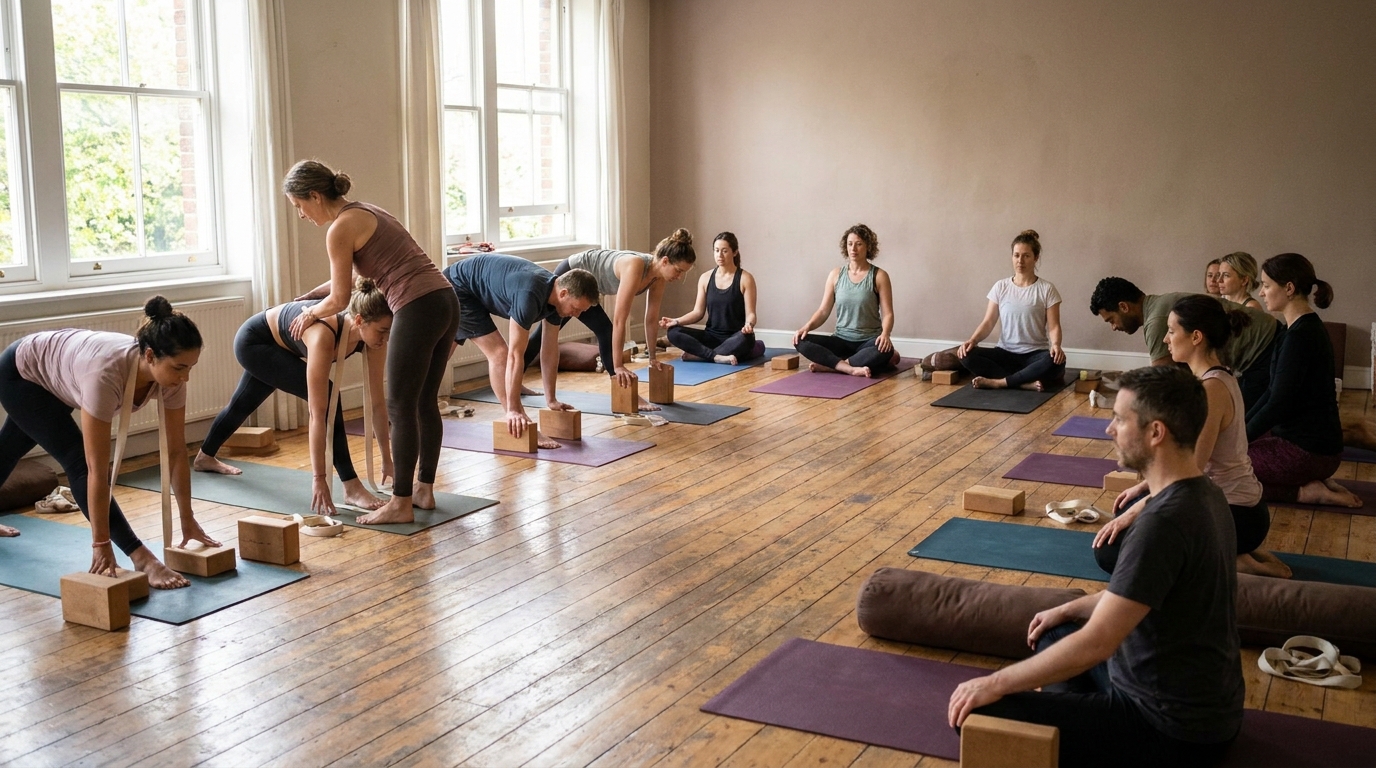
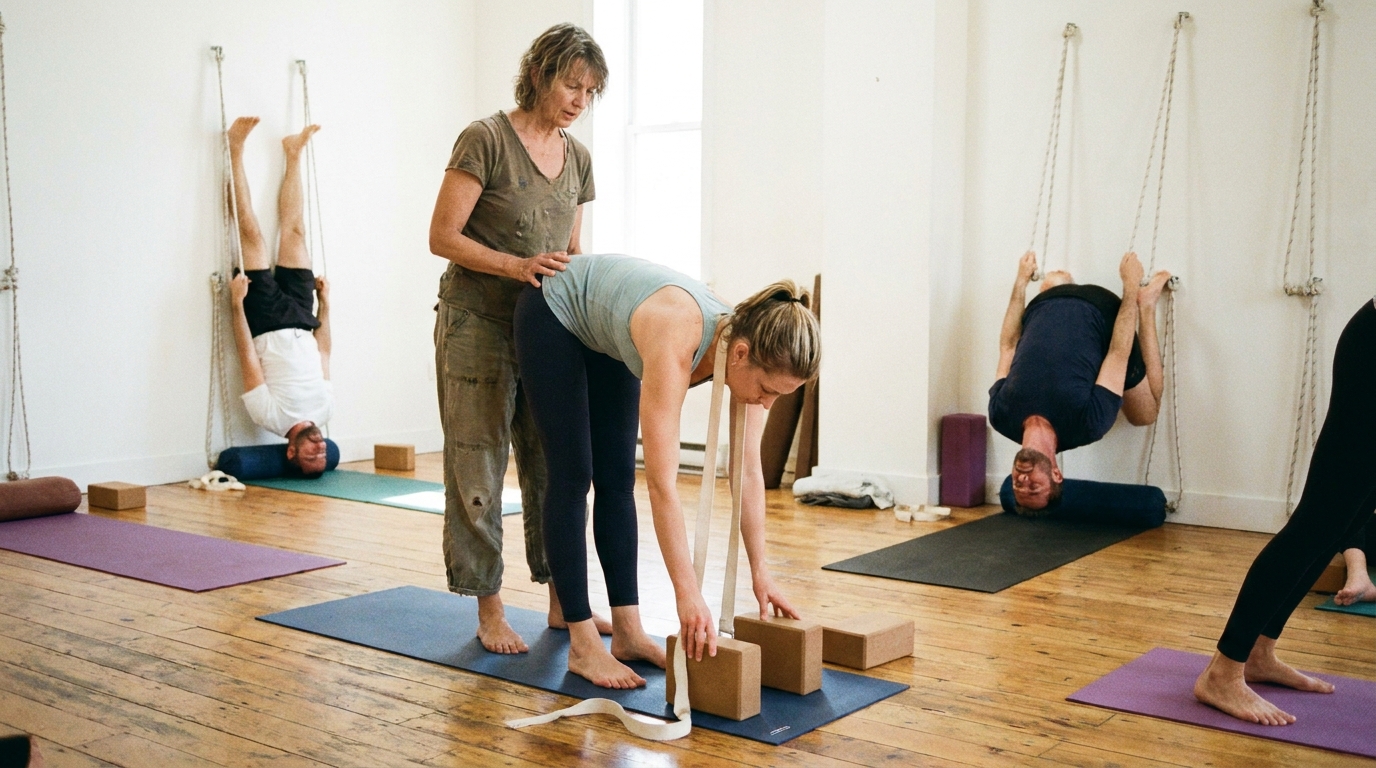
Iyengar Yoga is especially known for the use of props. Props are not signs of weakness. They are instruments of wisdom.
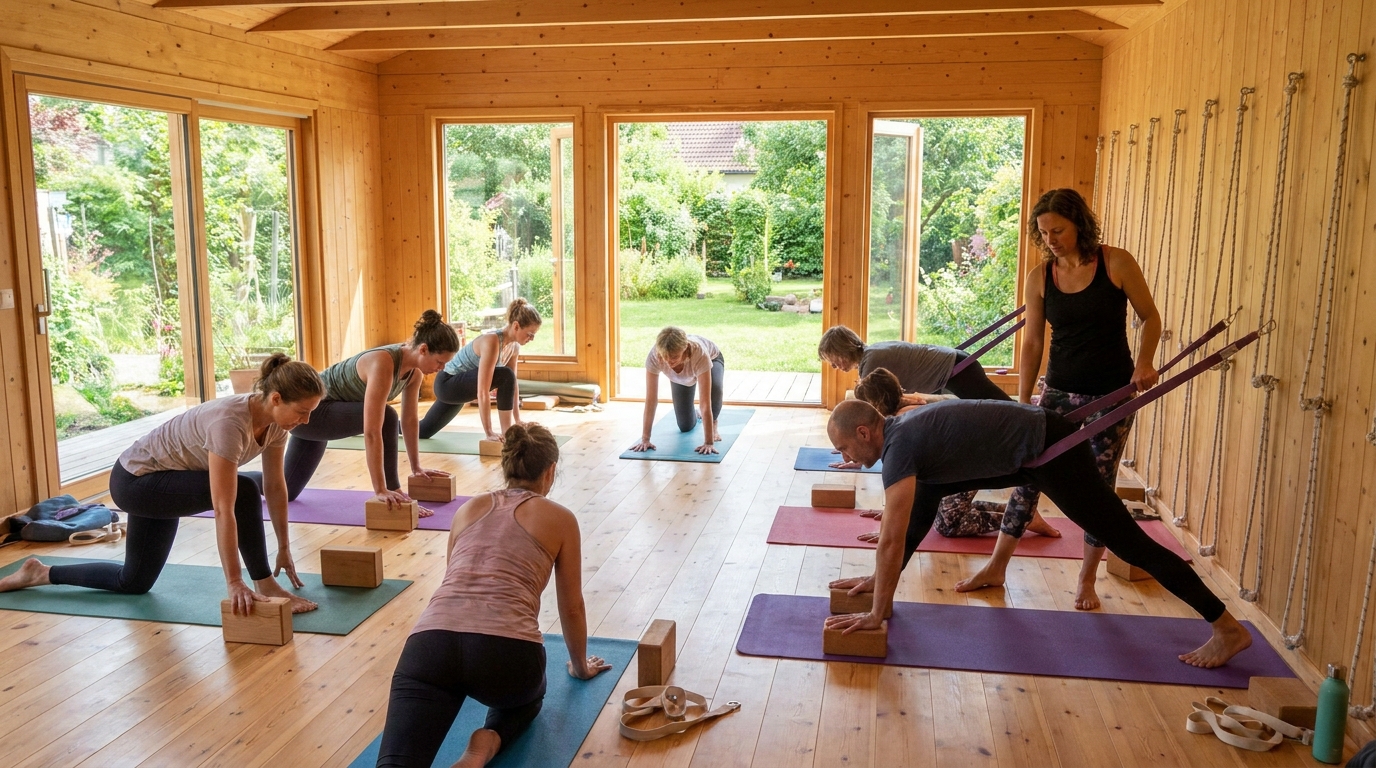
A block can bring the floor closer. A belt can help the arms and legs work without strain. A chair can support balance. A bolster can invite deep rest. A wall can teach direction and stability.
In this way, Iyengar Yoga welcomes many people who might otherwise feel excluded from yoga. Older adults, beginners, people with limited flexibility, those recovering from injury, and those with fatigue or stress can all benefit from modified and supported practice.
Props help the practitioner receive the essence of a pose without aggression. They teach us a beautiful devotional lesson: support is sacred.
Why Practice Iyengar Yoga?
To cultivate steadiness in body and mind
Many people come to Iyengar Yoga for physical reasons: back pain, poor posture, tight hips, weak legs, stiff shoulders, or lack of balance. These are valid and important reasons. The body deserves care.
But over time, practitioners often discover that the benefits of Iyengar Yoga go deeper. The mind becomes less scattered. The nervous system becomes calmer. The breath becomes more natural. There is a growing sense of inner steadiness.
In the Bhagavad Gita, Sri Krishna teaches the value of balance and moderation. In Chapter 6, he explains that yoga is not for one who eats too much or too little, sleeps too much or too little, but for one who lives with balance. Iyengar Yoga supports this balanced life through regular, thoughtful, embodied practice.
Each pose becomes a mirror. We notice where we overwork. We notice where we collapse. We notice impatience, fear, comparison, and pride. With humility, we begin again.
To develop discipline without harshness
The Sanskrit word abhyasa means steady practice. Patanjali describes abhyasa as the repeated effort to remain established in steadiness. Iyengar Yoga beautifully embodies this principle.
In class, a teacher may ask you to repeat a pose, refine an action, or stay a little longer than expected. At first, this can feel challenging. But gradually, you learn that discipline does not have to be harsh. It can be loving.
A devotional heart understands repetition. Just as one may repeat a prayer, a mantra, or an act of service, one can repeat Trikonasana—Triangle Pose—with sincerity. Each time, something new is revealed.
The practice says gently: “Come back. Pay attention. Offer your best. Let go of the rest.”
To make yoga accessible
One of the greatest benefits of Iyengar Yoga is accessibility. Because poses can be adapted with props, clear instructions, and careful sequencing, many students can safely participate.
This does not mean the practice is always easy. Iyengar Yoga can be deeply strengthening and demanding. But it is intelligent. It meets the practitioner where they are.
For example:
- A student who cannot touch the floor in a standing pose can use blocks.
- A student with tight shoulders can use a belt.
- A student with fatigue can practice supported poses.
- A student working on balance can use the wall.
- A student with limited mobility can practice certain poses with a chair.
This approach honors the person first. The goal is not to fit the body into a posture. The goal is to use the posture to awaken awareness, strength, and inner harmony.
The Physical Benefits of Iyengar Yoga
Improved posture and body awareness
In modern life, many of us sit for long hours. The shoulders round, the chest tightens, the lower back strains, and the neck becomes tense. Iyengar Yoga helps restore healthy posture by teaching the body how to align and support itself.
Standing poses such as Tadasana (Mountain Pose), Virabhadrasana (Warrior Pose), and Utthita Trikonasana (Extended Triangle Pose) develop strength in the legs, openness in the hips, and length in the spine.
Over time, students begin to carry this awareness into daily life. They notice how they sit at a desk, how they stand in line, how they lift objects, and how they breathe under stress.
This is one of the practical gifts of Iyengar Yoga: the practice does not end on the mat. It enters the kitchen, the workplace, the car, and the quiet moments before sleep.
Greater flexibility and strength
Iyengar Yoga helps increase flexibility, but not through forcing. Instead, it uses alignment and time. Poses are often held longer than in fast-flowing styles, allowing the muscles, joints, and connective tissues to gradually open.
At the same time, Iyengar Yoga builds strength. The legs learn to root. The arms learn to bear weight. The core becomes more responsive. The back body awakens.
This balanced development is important. Flexibility without strength can create instability. Strength without flexibility can create rigidity. Iyengar Yoga invites both: firmness and openness, effort and surrender.
In Sanskrit, this balance may remind us of sthira and sukha—steadiness and ease. These qualities are not only physical. They are also emotional and spiritual.
Support for joint health and mobility
Because Iyengar Yoga emphasizes precise action, it can help students understand how to move in ways that protect the joints. Knees, hips, shoulders, wrists, and ankles all benefit from mindful alignment.
For example, in standing poses, students learn to track the knee properly over the ankle. In seated poses, props may be used to lift the pelvis so the spine can lengthen without strain. In shoulder work, belts and wall support help create space instead of compression.
Of course, anyone with serious injury, chronic pain, or medical conditions should consult a qualified healthcare provider and practice with a certified Iyengar Yoga teacher. Yoga is powerful, and wise guidance matters.
Better balance and coordination
Balance is not only a physical skill. It is a conversation between the body, the senses, the breath, and the mind.
Iyengar Yoga includes poses that improve balance, such as Vrksasana (Tree Pose), standing leg actions, and wall-supported variations. These practices strengthen the feet and legs while improving concentration.
As balance improves, confidence often grows. This can be especially meaningful for older adults or anyone who feels uncertain in their body.
A stable body can support a stable mind. A stable mind can support a more peaceful life.
Check out the latest yoga guides on yoga guides for helpful tips and advice.
The Mental and Emotional Benefits of Iyengar Yoga
Calming the nervous system
Many people live in a state of constant stimulation. Phones, responsibilities, deadlines, noise, and worry keep the nervous system alert. Iyengar Yoga offers a structured way to come back to calm.
Supported poses are especially helpful. Poses such as supported Setu Bandha Sarvangasana (Bridge Pose), supported forward bends, and Viparita Karani (Legs Up the Wall Pose) can encourage relaxation and quiet breathing.
When the body feels supported, the mind receives a message: “You are safe enough to soften.”
This is not escape. It is restoration. A rested nervous system helps us respond to life with greater patience, kindness, and clarity.
Developing concentration
Iyengar Yoga trains attention. The teacher may guide students to observe the placement of the feet, the rotation of the thighs, the lift of the chest, the length of the side body, or the softness of the eyes.
At first, these details may feel like many instructions. But gradually they gather the mind. Instead of wandering into regret or anxiety, the mind becomes absorbed in present experience.
This relates to the Sanskrit word dharana, meaning concentration. In the eight limbs of yoga described by Patanjali, dharana is an important step toward meditation.
Iyengar Yoga can prepare the mind for meditation by teaching embodied attention. The posture becomes a doorway into stillness.
Reducing stress and emotional reactivity
When practiced regularly, Iyengar Yoga can help reduce stress. This happens through breath awareness, physical release, improved circulation, and the mental discipline of staying present.
But there is also something subtler. In a challenging pose, we meet our reactions. We may want to quit, push, compare, or judge ourselves. A wise practice teaches us to observe these patterns without being ruled by them.
In this way, Iyengar Yoga becomes emotional education.
We learn to stay steady in discomfort without violence. We learn to rest when rest is needed. We learn to accept help. We learn that progress is not always dramatic.
These lessons are deeply spiritual. They make us more humble, more patient, and more compassionate toward others.
The Spiritual Dimension of Iyengar Yoga
Yoga as union
The word yoga comes from the Sanskrit root yuj, meaning to yoke, join, or unite. Yoga points toward union: the integration of body, breath, mind, and spirit.
Iyengar Yoga may begin with physical alignment, but its deeper purpose is inner alignment. We learn to align our actions with awareness, our effort with sincerity, and our life with higher values.
In the devotional spirit of bhakti, each pose can become an offering. We do not practice merely to improve the body. We practice to purify attention, soften ego, and remember what is sacred.
You do not need to belong to any particular religion to experience this. The sacred may be understood as God, truth, love, consciousness, nature, or the quiet presence within the heart.
Iyengar Yoga welcomes sincere seekers of all backgrounds.
The body as a temple of practice
In many spiritual traditions, the body is honored as a temple. Iyengar Yoga helps us treat the body not as an object to criticize, but as a sacred field of learning.
This does not mean becoming attached to appearance. In fact, the practice often reveals how much suffering comes from comparison. Instead, we learn reverence.
The feet are not “just feet.” They are foundations. The spine is not “just the back.” It is a central channel of dignity. The breath is not “just air.” It is life moving through us.
This humble attention can become devotion.
As B.K.S. Iyengar often emphasized, the body is a gateway to the soul. By refining awareness in the body, we become more sensitive to the inner life.
Practicing with humility
Iyengar Yoga can be humbling. A simple pose may reveal weakness. A familiar pose may feel different from day to day. A prop may show us that we need support.
This humility is not discouraging. It is freeing.
Bhakti teaches that we do not have to be perfect to be loved. We only need sincerity. In the same way, yoga does not ask us to perform perfection. It asks us to show up truthfully.
Some days the practice is strong. Some days it is quiet. Some days we do very little. Still, if the heart is sincere, the practice bears fruit.
How to Practice Iyengar Yoga Safely and Effectively
Begin with a qualified teacher
Iyengar Yoga has a strong teacher training and certification tradition. A certified Iyengar Yoga teacher is trained to observe students carefully, give precise instructions, and offer appropriate modifications.
If you are new, attending a beginner class is highly recommended. Even if you have practiced other forms of yoga, Iyengar Yoga may introduce a new level of detail.
A good teacher will not rush you. They will help you understand the foundations, use props wisely, and build confidence step by step.
Start with foundational poses
Beginners often begin with standing poses, simple seated poses, gentle twists, and restorative poses. These teach essential actions and build strength.
Common beginner-friendly Iyengar Yoga poses include:
- Tadasana — Mountain Pose
- Utthita Trikonasana — Extended Triangle Pose
- Virabhadrasana II — Warrior II
- Adho Mukha Svanasana — Downward-Facing Dog
- Dandasana — Staff Pose
- Baddha Konasana — Bound Angle Pose
- Setu Bandha Sarvangasana — Bridge Pose
- Savasana — Corpse Pose, a deep rest posture
Each pose has layers. Do not worry about mastering them quickly. In Iyengar Yoga, the basics are never “basic” in a shallow way. They are rich, living teachings.
Use props with respect
Props can make practice safer and more effective. They help bring alignment, stability, and ease.
For home practice, you may begin with:
- One yoga mat
- Two blocks
- One belt
- Two or three firm blankets
- A wall space
- A sturdy chair, if available
If you do not have traditional props, simple household items may help. A thick book can sometimes act like a block. A scarf can sometimes act like a belt. A folded blanket can support the hips.
Use props not to avoid effort, but to discover intelligent effort.
Practice with patience
Iyengar Yoga rewards patience. Because the method is detailed, you may feel slow at first. This is natural.
Let the practice unfold like a prayer bead moving through the fingers—one breath, one action, one moment of awareness at a time.
A short, consistent practice is often more helpful than an intense practice done rarely. Even 15 to 20 minutes several times a week can bring meaningful change.
Remember: yoga is not a race. It is a relationship.
How Else Can Iyengar Yoga Support Daily Life?
For people with desk jobs
If you spend long hours sitting, Iyengar Yoga can help counteract the effects of desk posture. Chest-opening poses, shoulder work, standing poses, and supported backbends can bring relief from tightness.
A practical mini-practice might include:
- Standing in Tadasana for one minute
- Clasping the hands behind the back or using a belt to open the chest
- Practicing a supported forward bend with hands on a desk
- Resting with legs elevated after work
These small practices can refresh the body and calm the mind.
For older adults
Iyengar Yoga can be especially supportive for older adults because of its adaptability. Props, chairs, and walls can make poses safer and more accessible.
Benefits may include improved balance, joint mobility, posture, circulation, and confidence. Restorative poses may also support sleep and relaxation.
The key is appropriate guidance. A well-trained teacher can offer variations that honor each person’s condition.
For athletes and active people
Athletes often benefit from Iyengar Yoga because it reveals imbalances. Runners may discover tight hamstrings or hip flexors. Cyclists may need chest opening and spinal extension. Strength athletes may benefit from mobility and breath awareness.
Iyengar Yoga improves body intelligence. It can support recovery, reduce unnecessary strain, and improve movement efficiency.
Perhaps most importantly, it teaches athletes to listen. This listening can prevent injury and deepen respect for the body.
For stress, grief, and emotional fatigue
Life brings sorrow as well as joy. During grief, anxiety, or emotional exhaustion, a vigorous practice may not be appropriate. Iyengar Yoga offers restorative and supported practices that can hold the body gently.
Supported forward bends, reclining poses, and quiet inversions may help soothe the heart. The use of bolsters and blankets can create a sense of being held.
In difficult seasons, yoga does not demand that we “feel better” immediately. It offers a place to breathe, to be honest, and to rest in compassionate awareness.
A Simple Iyengar Yoga-Inspired Home Practice
Prepare your space
Choose a quiet area with a mat and a wall. Gather a belt, blocks, and folded blankets if you have them. Let the space be simple and clean.
Before beginning, pause. Bring your palms together if that feels natural. Take a quiet breath. You may offer your practice inwardly with words such as:
“May this practice bring clarity, humility, and kindness.”
This small intention transforms movement into devotion.
A gentle sequence for beginners
Try this simple sequence when you have about 25 to 35 minutes. Move slowly and avoid pain.
- Tadasana — Mountain Pose
Stand with feet hip-width or together. Spread the toes. Lift the chest gently. Breathe for one minute.
- Urdhva Hastasana — Upward Hands Pose
Raise the arms overhead, or keep hands on a belt if shoulders are tight. Lengthen the sides of the body.
- Utthita Trikonasana — Extended Triangle Pose with a block
Place the lower hand on a block instead of reaching for the floor. Keep the chest open and the legs steady.
- Virabhadrasana II — Warrior II
Bend the front knee carefully over the ankle. Extend through both arms. Stay for a few breaths on each side.
- Adho Mukha Svanasana — Downward-Facing Dog with support
Place hands on the wall or on blocks if the full pose feels difficult. Lengthen the spine.
- Baddha Konasana — Bound Angle Pose
Sit on folded blankets. Bring soles of the feet together. Let the knees release naturally, supported if needed.
- Setu Bandha Sarvangasana — Supported Bridge Pose
Lie down with a block or bolster under the sacrum if comfortable. Let the chest open softly.
- Savasana — Final Rest
Lie on your back with support under the knees if needed. Rest for five to ten minutes.
Practice notes
Do not rush. In Iyengar Yoga, the transition into and out of a pose matters. If something hurts sharply, come out. If you feel strain in the breath, reduce effort.
Let your breath be your guide. Let steadiness and ease be your companions.
Common Questions About Iyengar Yoga
Is Iyengar Yoga good for beginners?
Yes. Iyengar Yoga is excellent for beginners because it teaches clear foundations. The use of props makes the practice accessible, and the methodical instruction helps students understand what they are doing and why.
Beginners often appreciate the slower pace and detailed guidance. Instead of simply copying shapes, they learn the principles behind the poses.
Is Iyengar Yoga difficult?
Iyengar Yoga can be gentle, moderate, or challenging depending on the class and sequence. The precision can require focus and effort. Holding poses can build strength and endurance.
However, difficulty is not the same as force. A good Iyengar Yoga practice is intelligent. It challenges you while respecting your body.
Can Iyengar Yoga help with back pain?
Many people find Iyengar Yoga helpful for back care because it emphasizes alignment, spinal length, and balanced muscular action. Props can support the body and reduce strain.
However, back pain has many causes. If you have ongoing or severe pain, consult a healthcare professional and work with an experienced Iyengar Yoga teacher who can adapt the practice for your needs.
How often should I practice Iyengar Yoga?
If possible, practice two to four times per week. This may include one or two classes and short home practices. Consistency is more important than intensity.
Even a few mindful poses practiced regularly can bring benefit. Over time, the body remembers, the breath deepens, and the mind becomes more steady.
Bringing the Benefits of Iyengar Yoga Into the Heart
From alignment to awareness
The benefits of Iyengar Yoga are many: improved posture, flexibility, strength, balance, concentration, relaxation, and self-understanding. Yet the deepest benefit may be this: we become more aware.
We notice how we stand. We notice how we breathe. We notice how we react. We notice where we are kind to ourselves and where we are not.
This awareness is a sacred beginning.
When awareness grows, choice grows. We can choose patience instead of frustration. We can choose support instead of struggle. We can choose humility instead of comparison.
A devotional way to practice
In the mood of bhakti, practice is not about proving ourselves. It is about offering ourselves.
Each asana can become a small act of worship—not necessarily in a formal religious sense, but in the universal sense of reverence. Reverence for life. Reverence for breath. Reverence for the mystery that carries us.
When we step onto the mat, we may remember:
“This body is a gift. This breath is a gift. This moment is a gift.”
Then Iyengar Yoga becomes more than alignment of bones and muscles. It becomes alignment of the heart.
Walking forward with sincerity
Dear friend, if you feel called to explore Iyengar Yoga, begin simply. Find a qualified teacher if you can. Use props without shame. Practice patiently. Rest deeply. Let the teachings meet you exactly where you are.
You do not need to be flexible. You do not need to be young. You do not need to be spiritual in any particular way. You only need willingness.
The path of yoga opens step by step, breath by breath. With humility, steadiness, and devotion, the benefits of Iyengar Yoga can support not only your body, but your whole life.
FAQs
What is Iyengar Yoga?
Iyengar Yoga is a form of yoga that focuses on precision, alignment, and detailed instruction. It was developed by B.K.S. Iyengar and emphasizes the use of props such as belts, blocks, and blankets to assist in performing yoga poses with correct alignment.
What are the key principles of Iyengar Yoga?
The key principles of Iyengar Yoga include alignment, precision, sequencing, and timing. Practitioners are encouraged to pay close attention to the alignment of their bodies in each pose, and to use props to support their practice. The sequencing of poses is also important, as is the timing of each pose and the duration of the practice.
What are the benefits of practicing Iyengar Yoga?
Practicing Iyengar Yoga can lead to improved strength, flexibility, balance, and posture. It can also help reduce stress and anxiety, and promote a sense of well-being. Additionally, Iyengar Yoga is often used therapeutically to help with various health conditions and injuries.
Who can practice Iyengar Yoga?
Iyengar Yoga is suitable for people of all ages and abilities. The use of props makes it accessible to beginners and those with physical limitations, while the emphasis on precision and alignment makes it challenging for more experienced practitioners. It can be adapted to suit individual needs and is often used therapeutically.
How is Iyengar Yoga different from other forms of yoga?
Iyengar Yoga is distinct from other forms of yoga in its emphasis on alignment, precision, and the use of props. It also places a strong focus on the therapeutic benefits of yoga and is often used to address specific health concerns. Additionally, Iyengar Yoga is known for its detailed instruction and sequencing of poses.